Boatbuilding Lark Scow Part 1

Other posts on the Lark scow.


Peter Gilbert of the Erieau Lark fleet in Canada has started a new Lark scow (named Pinky Too, his Dad built Pinky 2 and Pinky 3) using the Kerr plans. He sends along some photos. The Kerr plans follow the original C.G. Davis plans in using a lot of frames. Instead of sawn frames, Peter has laminated the arc sections. He is planking the bottom of the Lark with plywood but with a hi-tech twist; he is using 3mm plywood with a carbon fiber sheathing (I wonder how this will square with the Erieau Y.C fleet as Peters construction may possibly result in a Lark considerably lighter than the current boats.)

I like how these builders determine fairness using a full glass of beer as a sight-line.


The solid timber side planks hold everything together before the bottom and deck goes on.


Read More..

May 23 24 St Michaels to Chesapeake City to Cape May 68 9 and 68 Miles

The first day of this holiday weekend John and I got underway at 7:15 after I water taxied Lene and the felines in their carrier to Johns car and we raised and secured the dink. And we docked at 8 pm. But we were not actually underway the whole time. We detoured into Annapolis after passing about eighty boat flying spinnakers, racing the other way, headed from Annapolis to St. Michaels. We stopped in Back Bay to fill the fuel tanks, which took an estimated 90 minutes of in and out and waiting on line for the fuel dock with only about 15 of those minutes for the actual fueling.
Our second stop of the day was when we run into the mud trying to enter the harbor on the south side of the C and D Canal, where I had stayed in 2006 on ILENE and last fall on sister ship Pandora. We backed right off the mud and tried to call the marina by phone and VHF. Finally, the person said, "I dont know if you can make it in now, near low tide, but hug the seawall on the left side of the entrance." This was not very reassuring. We had noticed a long high fixed dock with two or three small power boats tied up to it and a busy restaurant on the other side of the canal, less than a quarter of a mile back- Scheafers. Not seeing any sailboats there, I called to ask about depth and they said they had 20 feet minimum at the dock, which our depth meter later confirmed. But they "had to charge us their holiday rate", $2.50 per foot. The restaurant and bar were large and jammed with revelers. We had dinner there and the food was OK.  It seems the place burned down about ten years ago and has recently reopened. It is so easy to get in and out that this will be a place Ill return to, even though they do not have water, electricity or wifi.
Why did it take so long, you might ask. Well the tides were against us all day. We went down the Miles River from St. Michaels against the flood which turned to ebb when we rounded Bloody Point to go north up the Bay. Six hours later this should have changed but then we were confronted by water flowing toward us from the Delaware. Well we have had all-day good tides too, but not today.
John was great help all day, a knowledgeable cautious seaman.
His 28 S2 sloop, "Hearts Content" passed its survey the day before with flying colors. "The best maintained 35 year old S2 I have ever surveyed" said the surveyor. She was Johns friend for the last 25 years, but he also has a 22 foot power boat, "Dixie," and he was not using the sloop and has found her a good home. Second happiest bittersweet day in a mans life: when he sells his boat.
Next morning we continued in the canal starting at 7:15 and found favorable tide. Belt and suspenders, do you think:
No, just an optical illusion with the arch further away and the pretty suspension bridge that Lene drove over the day before in the foreground.
Once in Delaware Bay, the tide was an even bigger help and we made over nine knots until noon. Delaware Bay is a wide boring passage except when freighters pass you by. See bow wake.
As the day wore on, the wind came up strongly, with about 35 knots and gusts to 45 showing on our meter, (though I sense that it reads about five knots too fast). So we had only the small jib and were beating down the Bay. The tricky part was rounding Cape May. The outer passage is a long way around some shoals, which would have added about the miles to our trip in rough weather toward the end of the day. The inner passage saves those miles but put ILENEs port side only about .2 miles from the beach with those big winds and the big waves they created trying to push her onto the beach. We had furled the small jib to gain control over safety for this part of the passage. John wanted the more cautious longer passage, as had part of my crew in 2006 when we did this in calmer weather. We have pictures of the beach with its lighthouse taken from this in close route on this blog in June 2012, on a rather calm day and had done the trip in the opposite direction last fall. Today we were too busy for pictures. it was a two person operation. John steered or to be more precise, controlled the autopilot and watched the waves. One of them sent a spray of water up over the boat soaking him completely. My job wasq operate the InavX on Lenes Ipad, while crouched in the companionway, to protect it from the spray and shade it from the sun. I directed, for example: "Turn right ten degrees." It was like instrument flight rules or sailing in thick fog. I directed our course from the electronic chart, around shoals charted as little as nine feet deep, keeping us in water at least 13 feet deep, without looking up to see where we actually were or where we were going. It was scary but we made it.
Once around the Cape, we turned more north toward the two stone seawalls that mark and protect the channel entrance into Cape May Harbor from the Atlantic. It seemed that we would be surfing down waves barreling directly into the harbor so I turned toward the beach for a practice run in that direction and ILENE seemed to handle it well. In the reality, however, the waves were at about a twenty degree angle from the channel and our passage between the seawalls was relatively easy. We anchored near the Coast Guard Station in about ten feet of water off the green side of the channel with sixty feet of snubbed chain. We were one of about six boats there, each far enough from the others and protected from the SW winds by the land mass of the Cape. John was a bit nauseous, though more from nerves than motion sickness, I think.
We were in by 5:30 and after a breather it was time for dinner. I have tried to get John to try foods that, while within his vegetarian practice, were different from his routine. Tonight we shared his food. I sauteed and steamed some veggies, fake chicken strips and onions, mixed them with whole wheat pasta and dressed it with soy sauce and grated cheese. Pretty good, and it better be because the leftovers is tomorrows dinner too.

Read More..

Rhode River to Cambridge and Three Lay Days in Cambridge October 13 17 38 7 Miles

First the passage: The wind was predicted at 5 knots, building to 15, in our face. Not pleasant, but manageable. It came from the predicted direction, a bit east of south, but at  20 to 25 knots and one has to add five to that to account for our boats speed into it!  And with Chesapeake Bay running generally north-south, the wind had time to work up large stiff waves of up to five feet. ILENE was pitching in these waves, some of them breaking over her bow, throwing spray back onto us. And with both these waves and the wind pushing us backwards, we were making only about four knots over the ground -- making for a long day to cover the 34 miles involved.

What to do. We changed course by 35 degrees, with the engine still working at its high speed for continuous use, 2500 rpms, and put out the small jib. Now less pitching, speed up to over six knots and a whole lot of heeling. The Saga owners network is having a discussion of the merits of adding  a ton of extra lead at the bottom of the keel (a sole under the keels foot as it were) and with Lene reporting this was on her "ten worst passages" list, I think the time has finally come to bite the financial bullet and do this -- next winter, when the boat is hauled. I thought of taking photos for you, or video, which could have shown the excitement, but decided to keep the salt water off the iPad, which was in a ziplock bag.

Turning a bit east, into the Choptank River, the wind was 60 to 80 degrees off the starboard bow and our speed was over seven knots with the throttle turned way down.  But this wide but shallow river twists and turns and when we came to a point where tacking in the channel would have been required we elected to furl the small sail and motor the rest of the way.  The trip took seven hours, from 11 to 6.

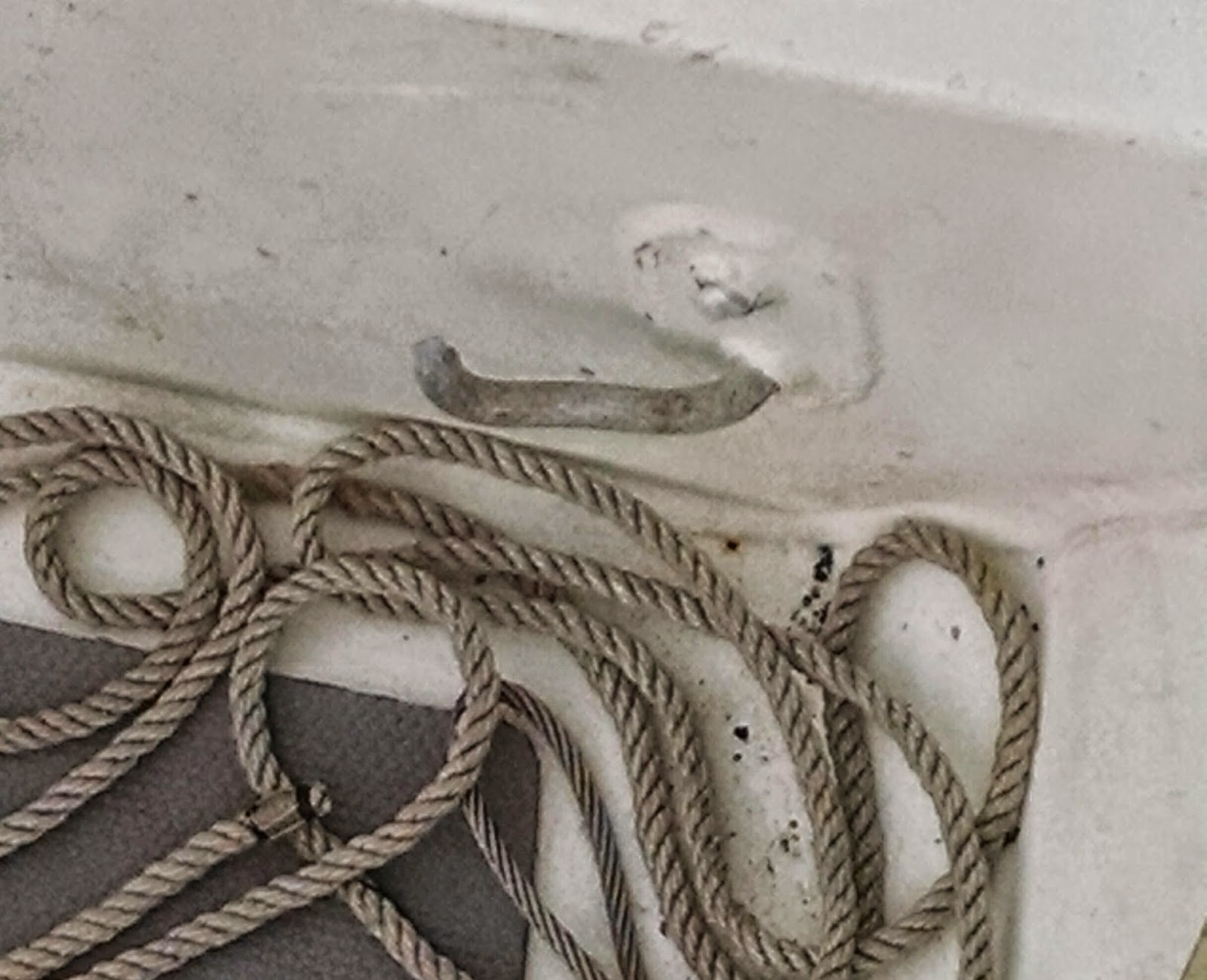
The landing at a dock in the Cambridge YC was very poor due to Captain Roger forgetting an important rule: always check the wind direction when attempting a landing at a dock. Maybe I was tired -- a reason but not an excuse. Anyway, the wind blew us onto the dock. We should have aimed further away from the dock, stopped and let the wind blow us to the Tee dock. Instead, with some way still on, we crashed our starboard quarter with the dinghy, hanging from its davits athwart the stern and protruding a few inches out past the side of the boat on each side, catching the dinks bow on one of the pilings that support the fixed height dock.  The painter, which is one of three lines used to snug the dinghy to the boat, parted (here reattached and a foot shorter),
and one of the welded aluminum


 padeyes holding up the bow ripped open.
But we landed and enjoyed three days at the YC, though the first of them was rainy.


On the sunny days that followed we enjoyed this view from ILENE of a replica of a screwpile lighthouse at the adjacent marina. I visited our friend, Johns meticulously maintained 28 foot S2, "Hearts Content" there.
 John, a former New Yorker and Harlemite was the best host one could find and our reason for staying in Cambridge. He has many talents in boating and as a mechanic, and he has a whole lot of power tools and the knowledge of how to use them. He rebuilt the interiors of the Plaza hotel and Columbia Universitys Butler Library as well as working for 15 years in NY theater, both on the stage and behind it. A gentleman and a pleasure to be with who put himself at our service. 
He drove us all around the town (population 12,250) showing us where everything was, took us to the post office to mail time sensitive mail, to the hardware store where we got a stainless steel padeye, bolts split washers, to the supermarket, several times, for provisions, to his home where we hacked off the extra length of the 1/2" bolts of the padeye and chamfered the edges, did our laundry and printed out a letter that was on our computer. He lent us one of his cars. He came to the boat and "helped" (lets just say he did the jobs with me as helper/learner/doer of the easy parts). He ground off the remnants of the old aluminum padeye, drilled the 1/2 inch holes for the new bolts
and we attached the new stainless padeye -- stronger than before!
We also replaced the old carburetor with the new one which had been fedexed to his house and he showed me how to adjust the idle and it works again!


We spent our days here with John and actually stayed the fourth night, when it was much calmer, at the wall of the town basin, rent free.
For our stay in the basin, he suggested the creation of the fender board, shown here, which uses two fenders and a hanging board to keep the pilings from harming the boat.
We watched Johns TV. He took us to his favorite restaurants and bar, Leaky Petes, where we had Natty Bos (National Bohemian beer). We tried scrapple, and crab, oyster and fish.


Cambridge is a very sleepy town, which has seen better times, especially its downtown district, which was devastated by suburban stores, fires, the recession and greed. We toured its Arts Center, and visited its Maritime Museum
and the Harriet Tubman Museum, but  the last two were closed.


Here are the kitties exploring a neighboring boat at the YC; maybe they smelled fish.
And I just loved this one, which I call "Still Life with Boat".

On our last day John took us on a long car ride to the southernmost of the three Hoopers Islands, connected by road and only a few feet above sea level, and populated mostly by watermen (crab and oyster harvesters) and their families. These islands were reached after driving through the Blackwater Wildlife Preserve, a huge swampy expanse.  We had lunch at Old Saltys

which has this wonderful view of mainland Maryland, the thin line at the horizon, across the Bay,
where we will be going next. John and I are planning the next leg of the cruise, I wish we could have persuaded him to come along for a few days.
Read More..

Archipelago Rally 2014

Earwigoagin has been reporting on the exploits of the Tuthill sisters racing their boat-speed challenged Snark in this one-race, come one, come all, Portsmouth handicap event hosted, every November, in a different nook and cranny of Rhode Island coastline.
  • For the Tuthill sisters racing their Snark in the 2012 event, click here.
  • For the Tuthill sisters racing their Snark in the 2013 event, click here.
This year (gasp!) the Tuthill sisters jettisoned their Snark for the race, thinking they had upped their game with a lateen-rigged dink and. as it is frequently fore-ordained when you change a good thing, they unfortunately dropped the rig during the race (looks like the jury-rigged thwart lashing to hold up the mast failed). The younger sister, usually a bored, disinterested observer, was now called to the thankless and ultimately futile duty of becoming a human sidestay. These two documented the race and the disaster in a very amusing video.


Originator Chris Museler was undoubtedly pleased to have +40 boats attend this year (including the hastily splashed Crosby Skimmer Moth). I have lifted some photos from Rufus Van Gruissens album.

The Tuthill sisters with Maharaja in "reef" mode.


My favorite "micro" dinghy, the Cape Cod Frosty.


A catboat and Penquin at the take-out ramp.


This fellow in the Zuma dinghy has a passing facial resemblance to the blogmeister (at least the mustache).


Click here for more photos from the Archipelago Rally Facebook page.

Read More..

Another Fun Filled Weekend But A Harrowing Problem At The End

Friday, Bob and Laura of our Club organized a fun sail down to The Battery and back in which about ten Club boats participated. We rendezvoused with Bob and Laura and their boat, "Thai Hot," when ILENE was in the West Indies (see Blog, Jan 22, 2012, Sint Maarten).  In addition to Witty and Alpha Girl, we enjoyed the company of Rhoda and Lloyd, Christine and Heather and Mendy. We left the mooring at 5:45 pm and had daylight all the way down, passing many memorable urban sights with a favorable tide. Actually, the timing of the turn of the tide was the key to the success of this voyage; Thanks, Bob!
Hells Gate with Triboro (now RFK) behind
59th St (Now Ed Koch) Bridge
Bright lights in the big city
We had the main up the whole way but the motor was on except for perhaps a bit more than an hour, near the destination and starting back up. I got yelled at by the captain of a tug with barges who thought I was too close when we were near the Statue. He hailed us over his loudspeaker: "Ilene, you are an idiot!"  Well we were not that near to him and in fact I did not hear his yell, though the others did. After the tide turned, we enjoyed favorable tide on the way back as well, arriving on the mooring six hours after starting, at 11:45 pm. Having misplaced the big flashlight (since found), finding our mooring in the dark was a challenge, but we saw it on the first try.

After sleeping aboard, we sailed on Saturday for about four hours with friends I know through Lene: Simone, who had sailed with us up at Mt. Desert Island last summer, and her wife, Alison. They are eager and avid sailors. Also, Susan and Andrew, who were newbies but took the helm and acquitted themselves well. Then dinner at the Club and a good nights sleep. The photos of this group are in my former cell phone which, alas, lies on the bottom of Eastchester Bay. Oops!

Sunday we were supposed to sail with a couple of attorneys who Lene had placed, but the husbands work got crazy at the last minute so they had to cancel. Hey, I was an attorney so I know such things happen. Lene made other plans, not including use of our car and I called Lenes cousin Judy, to find out if her twin sons, Jake and Jared, were available -- and they were.

The lads are about 17 years old. I have been wanting to sail with them for at least a decade and now they are old enough and we had a good sail. The wind had been forecast for only single digits but came up double that. So using the main, we furled the small jib and made plenty of speed with one sail. We were close hauled on a port tack from the mooring to Great Neck, on a starboard close reach to and through Hart Island Sound, reached deeply into Manhassett Bay, past the Clubs, the race in progress and the big anchored party yacht until the water got to ten feet before turning for home. Jake did most of the steering, cast off and picked up the mooring, hauled up the main, and trimmed the sails, giving my sore shoulder a rest. Jake is rapidly becoming a good sailor.
Jared felt a bit under the weather especially on the beating courses, but he hung on bravely. His face does not look as green as he felt.

The two cats stayed mostly below, in each end of a long narrow cabinet on the port side of the forward head, where we store towels. It is closed by two sliding panels and by pushing them toward the center, the cats have openings into two snug padded berths. They both briefly stuck their noses out of the companionway, on the way back, to look around. On the way out, during the port tack, two of the transverse drawers under the pullman berth slid out onto the cabin sole and I had put them back -- more securely.  Once on the mooring, sails and lines all secured and stowed, the wheel locked in place, the instruments turned off, and the next question before calling the launch was: "Wheres Alphie?"  The boys and I spent at least an hour looking in every conceivable place. All of the stuff in the aft cabin was removed and, not finding a cat there the stuff was replaced and its door closed. All of the towels were removed from the cats hiding hole. Compartment by compartment, we systematically but frantically searched, with no luck. Not in the fridge either. Nor topside. Knowing Alphies penchant for crawling into the stack pack (see prior post) we searched there too and raised that sail and felt for bulges on the sides of the lower sail. Many searches were repeated.

Finally the call to Lene that I dreaded ever having to make. Lets just say that she did not take the news that Alphie was missing calmly. I drove the twins back to NJ and returned to the boat; Lene took the number six subway and 29 bus, arriving two minutes before I did. We resumed the search. Within a few minutes she heard a faint mewl, not the MEEOWWW!!! that Alphie is capable of. Thank goodness! She was aboard!  What a relief!  But where?  We tried to localize the sound and concluded that it was coming from the compartment with the pullman berth, where we sleep. So we took off the huge mattress and bed clothes, and moved this into the salon and then I unscrewed the part of the plywood panel on which the mattress lies that covers, among other things, the six drawers, two of which had slid out. But these drawers slide in cubbies with 1/2 inch plywood on the top, the bottom and both sides. here is the front of the forward ones with the drawers out:
So how could Alfie have gotten into wherever she was through there? Oh, I did not know this but the cubbies have no backs and there is a narrow space, perhaps 2.5 inches wide, between the back of the cubbies and the longitudinal bulkhead behind which the water maker lives. She had squeezed through that gap!
Back of cubbies, from the top - where she had squeezed through
Next removal was a large tray about 2.5 by 3 and four inches deep, that fits over the drawers but under the plywood platform for the mattress and is held in place by a dozen screws. This tray opens through a covered cutout in the top and we store my wet suit in there. And then Alphies head was visible in the dry but dirty bilge under the drawers at the front end.
Fiberglass stringer seen from above
 But the next couple of hours of trying to coax her out were unavailing. She had jumped over a strong longitudinal fiberglass stringer into the lowest part of this bilge, below where my arm could reach. We tried coaxing her out with hands containing a few kibbles but she reached this food with her head without providing a way to grab the scruff of her neck. The same with a line: she loves chasing strings and put out paws to play, but did not come out far enough to be grabbed. I sawed a six inch square hole in the bottom of the forward lower cubbie with the Dremel tool, using up three carborundum discs, but there was still a ply of the plywood that was not cut and hammering down with the rubber mallet did not create the hole I sought. The sawing and hammering probably scared the poor kittie half to death, though.  Lene called friends, including Bob, of  "Pandora", another Saga 43. He is a master woodworker. He advised against tearing the boat further apart; I agreed, not being able to see what was connected to what - how to do it. It appears that glue was use in addition to screws. So we sat and waited and in a half an hour -- out crawled Alphie. It was after ten oclock; we called the launch and went home, leaving ILENE a wreck.

Next day I spent three hours cleaning, putting her back together, making the bed, and putting a thinned coat of  new varnish on one side of the cafe doors, using the newspaper covered salon table as the work bench. Here they can dry without cats footprints. Several of the books I have read about the exploits of cruisers have chapters entitled to the effect: "The Night [insert name of cat] Went Missing." Most people would say that sailing with cats is not worth the trouble. We love them though.


Read More..

Pug Ugly The Scow Mini Transat 6 5

Dave Raison, in his latest scow Mini Transat 6.5, won the Mini Fastnet this past June. There are now other scow Mini 6.5s appearing. Swiss Simon Koster put one together he has named eight Cubed after the number he sails under. Included below are some photos of his new creation.

Make no bones about, these sailboats are Uglee.....High freeboard on a scow shape is not pretty. Simon Koster waved the ugly stick even more by making his cabin top very blocky.

From the The Simpsons, a quote by bartender Moe before he underwent plastic surgery.

Moe
"Ive been called ugly, pug-ugly, fugly, pug-fugly, but never ugly-ugly."


Ill go with pug ugly. I like scows. I like different. I like that, with these shapes, form follows function. Some would call these Mini 6.5 scows cute. (Can you call a sailboat cute?).

From this bottom-up, bow-on angle, combined with the paint scheme, eight Cubed appears to have the bottom of a rubber ducky bathroom toy.


Ah! Thats more like it. The familiar wide arse of a Mini-Transat 6.5.


You can see the odd split, blocky looking, almost comical cabin house with forward facing window in this photo of eight Cubed hanging in the shop before the initial launch.


A video of the start of the Mini-Fastnet. Winner David Raison in #865 with the distinctive blue jib can be seen starting about 56 seconds into the video and then at 2:20. 8-Cubed shows up at the 1:43 mark.


Read More..

Sewing Machine For Upholstery and Enclosure Canvas

A few years back,my girlfriend and I purchased a 1962 Singer Fashion Mate 237 from my aunt for a song.Soon after,I located an owners manual for the sewing machine on Ebay.Reading through it,I have found that the sewing machine is capable of doing upholstery and canvas sail cloth work.I was a bit surprised that the sewing machine is rated for canvas sailcloth.The sewing machine is heavy,around 80 pounds.I believe the body is cast steel.I know the internals are high quality precision machined steel,possibly hardened.I worked for a friend that did auto,rv,and marine upholstery.His father also owned a household upholstery shop.I worked for him when we didnt have work.At those two shops,I used a Pfaff and a Consew.I briefly had an auto upholstery shop where I leased some off brand sewing machine.It was a horible machine that wouldnt hold its timing and constantly bent or broke needles.Its not fun having a needle fly past your eye at sub light speed.Always wear safety glasses.Sounds goof,I know,but flying needles can be dangerous.Some of the newer industrial commercial machines have clear plastic glass guards to protect the operator.I dont need,nor can I afford,to go with an industrial sewing machine.

Recently,I had been looking into Sailrite sewing machines.I know that when I build my boat,I will want to do all the work I can myself.After viewing some of their sewing machines,I feel confident that my sewing machine will handle the job.I am not knocking Sailrite sewing machines.They are quality.My sewing machine may not have all the options and accessories as a Sailrite,but it is more than enough for the simplistic interior and canvas work that will be on my boat.I will have a few seat cushions,interior,and exterior window coverings.I wont have a flybridge to deal with covering and/or enclosing.I will enclose my rear deck.I will have a rack over my rear deck to carry my dinghy.My plan is to hang my canvas from the rack like the old external frame tents used in the 1950s and 60s.It will seal to the back of the cabin with a belt rail system similar to those used on Jeep CJs and Wranglers.All in all,there wont be as much sewing on my boat compared to something like a Bayliner of comparable dimensions.


Here are some pictures of my sewing machine.It came with a beat up cheapo cabinet.I will build a small table to set it in when I get ready to do the upholstery for my boat.


Photobucket Here is the cabinet open.The sewing machine nestles down inside of it. Photobucket Lifting the stand allows the sewing machine to rotate up and out of the cabinet. Photobucket Here is the speed control(gas) pedal.It is aluminum with a plastic pedal. Photobucket Here is the machine rotated up out of the cabinet.You can see all the precision steel machine work.Also visible is the date stamp,8162 or August 1,1962. Photobucket This machine has a lot more options than first appears.About 60 different ways to set up for sewing.It will even do embroidery and buttons.Thats gotta be useful. Photobucket Here is a picture of the built in light and the motor.Dont be fooled by the motors compact size,it got some power. Photobucket
Read More..