Tampilkan postingan dengan label 8. Tampilkan semua postingan

October 25 Portsmouth VA to Elizabeth City NC 43 8 Nautical Miles

Today we traversed the Great Dismal Swamp, one of three inland routes between Norfolk and North Carolina. This is the westernmost route and most of it is a very straight and narrow (about 50 feetwide) canal
that is not very deep (about eight to ten feet).A new route to a new port.
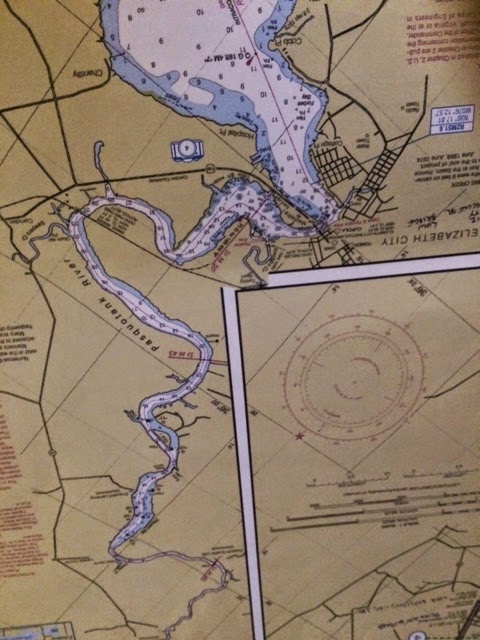
One thing about it is easier. Normally I piece together many legs of a days journey, measure the length of each lag and add them together. But in the ditch, the charts show the mileposts from mile zero in Norfolk to over a thousand miles later in Florida. But these are in statute (land) miles and so one must take only 85 percent of them to get the nautical miles. Today we started half mile north of mile zero and Elizabeth City is at mile 51, leading to 43.8 nautical miles. And describing "legs" would have been difficult after we exited the canal proper into the Pasquatank River, which is nothing if not sinuous. Oops, upside down. Eliz. City is the black boxes (streets) toward the upper right, the old down town.
But this path is more challenging because there is no sailing allowed, and the road is so narrow, requiring constant attention as when driving a car. Also there are hazards above and below. Below are "deadheads" -- water soaked tree stumps that lay on the bottom and give us a thump when we hit them. We know they are there and that we will take a few hits (four today) but unlike coral heads in the Bahamas, they do not sink your boat. The peril above is tree branches that overhang the canal and get whacked by our mast (about three times today).


Here is some of the flora we harvested with our mast and shrouds, showing also the straightness of the canal, the diagonal to the lower left corner.


It was a long day, but warm at last and sunny, and windless. Normally we dont like windless days but no sailing is possible in the canals so no big loss. We got underway at seven in morning mist, and headed up the Elizabeth River to make it to the first lock, at the northern end of the swamp, at its 8:30 scheduled opening.


Here we are, all five boats, locked up together.
The lock business and the associated bridge took an hour and we timed the next 22 miles at five knots to arrive at the second and last lock for its 1:30 opening, and arrived in Elizabeth City at about 5 pm. A long, slow, ten hour day.
Yesterday we crossed paths with a mammoth container ship; today a more modest craft.
Eliz. City calls itself "The Harbor of Hospitality" and this billboard
is 50 feet from our slip. It proves this true by providing seventeen free guest docks, and we took one. In the morning, a man and his daughter offered us a ride, three miles, to the supermarket and Judy and Rich, who work for the Coast Guard, gave us a lift back. Yep, a friendly town. We are bow in. On the way in we looped our starboard stern line over a piling and  then ran forward to hand a bow line to one of the friendly volunteers who secured it to a piling near land on the port side. Easy, in the absence of wind. The other two lines loop around pilings off the other two corners and I added a spring line to keep us from crashing into the street ahead of us if there was a surge (but no surge tonight) and we were totally secure. Black line is starboard aft line and white is spring line.
The last step was loosening the starboard forward tether and tightening the port one to bring our bow above the short stubby dock so that we could climb down from the bowsprit onto it.


On arrival we took free shoreside showers
and had dinner ashore before returning for the evening. There was a very easy camraderie among the crews of the boats here, all enthusiastic about their similar but individual adventures. Next to us, separated only by our biggest fender, is a beautiful Shannon, "Whisper", whose three very young, very blond children came aboard to play with our crew. Witty was not really a happy camper in this, but he played along well enough. I missed the photo op.
Read More..

We Are OFF! NY to Annapolis October 8 10 268 Miles

Our first problem was discovered when we had to use the dinghy to go to dinner on City Island because the Clubs launch service ends at 6 pm in the waning days of the season: it started right up but stopped in five seconds. So we paddled.  And the night of the seventh was unpleasantly rocky on the mooring due to strong SW winds kicking up big chop in Eastchester Bay, impeding sleep.

The passage was from 9:45 am on the eighth until 7:30 am on the tenth, 45.75 hours with a two hour "stop" to be discussed later, so 43.75 hours underway. The first of the two days (NYC and the Atlantic coast of New Jersey) was warmer than expected for the season, both day and night, with sunny clear skies and a big full moon; the second of the days (Delaware Bay, the C and D Canal and Chesapeake Bay) was raw and cloudy but not frigid and not rainy. This chart, created by Jims Spot device shows our route, except that it connects the dots every four hours or so and hence cuts off the corners and shows us crossing land. [Image to be added.]
We actually left, after mango pancakes, about an hour too early due to my impatience so we did not experience the favorable tide while we fought strong headwinds until near Hellsgate when the tide started flushing us out of NY Harbor. A tug with four barges (2 x 2) came up behind us near Hellsgate and called ILENE by name to advise that we would apparently be going through Hellsgate together and that his four barges would be swinging to port. I did a short 360 degree loop to let him pass and observed that his tow did indeed sweep far to his port side and "crab" through the most problematic tidal strait of the passage on a diagonal. We passed parallel to the FDR Drive with its snarled traffic on which I drive so often to get to the Club.


Here is the Freedom Tower to the left, currently New Yorks tallest structure, and a tower of the Brooklyn Bridge to the right, which held that title in the 1880s.


We put up sails, starting with double reefed main and small jib, after we passed Governors Island and we were on starboard tack all the way to Cape May, though we gradually shook out the reefs and changed back and forth to the genoa when passing through periods of apparent winds of 20-25 knots and periods where they were in the mid teens. The Verranzano Bridge, our ninth of the passage, was emotionally my last point in New York until around May, 2015.
Unlike the similar passage on Pandora about two weeks before, on which the wind was never forward of the beam, on this trip it was almost never aft of the beam, though rarely close hauled and predominantly about 60 degrees off the bow. 

Jim, who made the trip on both boats is a great man to have aboard. He is a fellow Cornellian, an engineer and very knowledgeable as a sailor though he wears his experts mantle lightly, without a trace of the arrogance that some experts have -- laid back and a pleasure to sail with. He agreed to my request to sleep the earlier part of each night and stand the later night watch.  During our first night I was "racing" a green light that started off our port bow. At times he would get ahead and by changing sails, at times, I would get ahead. Our speed varied from 3.5 to 8.1 knots depending on the wind. When very close I hailed the "sailboat with another sailboat on your port quarter", identified ILENE and thanked him "for keeping me awake last night". He reciprocated the thanks and identified himself as "Momo" a Valiant 40, here shown off  Wildwood,
bound for Florida with a planned stop for a day in Cape May harbor. I told him I hoped we would meet up with them in Florida or along the way. He is a very good sailor because ILENE is a faster boat but he kept up.

Jim took the watch for most of the passage up Delaware Bay, in which we avoided the worst of the adverse tide. Having rounded Cape May at about 9 a.m., using the inside passage a hundred yards off the beach, with main and engine but no headsail, Jim suggested a diagonal course, away from but toward the shipping channel at Miah Maull light, after which we stayed just outside the channel on its right side almost all the way up. A tug with barges ran near adjacent to us most of the way and we put up the headsail when possible to gain speed and sailed without engine, close reaching on port. Unfortunately, when the tug got ahead of us during lighter winds, we got long doses of his diesel fumes. About 5-10 miles before the Canal, when we are slightly ahead of him, I called on VHF and told him our plan to cut across his bow to get to the other side of the channel in anticipation of our left turn into the Canal and he replied "OK".

As we entered the canal Jim came up with the good idea to stop for a couple of hours to avoid the worst of the adverse tidal flow. We would tie up for free at a dock in the Summit North Marina on the north side of the Canal to have dinner in their excellent Aqua Sol Restaurant. And we shared a bottle of red and a nice assortment of appetizers while motoring in the canal. This is the same marina where ILENE spent a night on our last trip in June 2012 and where Pandora went in for fuel two weeks ago. But on our way in, going slowly, of course, we went aground. We used the preventer to swing the boom, with Jim sitting on its end, out to port, in an effort to tilt the boat and break us free. No luck, we were stuck hard. And we created this lead line, the old fashioned depth meter, out of a green divers weight, a wire wrap, a length of light line and red tape to mark where the wet part old the line ended.

Yep, we were stuck alright and it was mud, which you can see,  dried on the bottom of the weight. What to do? Wait for the tide to come in and float us off. I took the watch and two hours later, at about ten, I saw us drift, turned on the engine and woke Jim.  We motored to the inner end of the cul de sac, turned in the deep turning basin and headed out of there.  Then I slept for four hours until 2 a.m. while Jim took us out of the Canal and into the Bay.  I took the watch from 2 until 7:10 a.m., when GPS put us ten minutes from the red daymark guarding Back Bay harbor of Annapolis, where Jim lives with Ann and where we docked at Bert Jabins Marina -- where ILENE had stood on the hard during the winter of 2005 in which we bought her.
Ann came over to take us to breakfast at Grumps, an Annapolis breakfast institution, where no two coffee mugs ever match. But the Captain ordered another batch of pancakes and put Jim to work peeling mangos for the three of us.
Then how to best utilize the time before Lenes arrival at about 4 pm. Well the most critical task was fixing the outboard, the engine of our car. And it being Friday, when mechanics are at work, I searched and found Steve of A and B Yachtsmen, who disassembled the carburetor, cleaned the rust from it, and emptied our fuel tank and line. She runs again! We are across the dock from a beautiful Tayana 55, "Karina"
owned by Dr. Miles (both M.D. and a boat doctor) and Ann, who are leaders in the Caribbean 1500. Ann gave Ilene a lot of good advice about sailing with cats in 2010 and unfortunately their cat has gone to heaven. I introduced myself as a graduate of the 2010 run and he pretended to remember me and invited us to an Alumni reunion we attended that night.

Before that I washed Ilenes salt crust and New York grime and freshened our water supply, cleaned up the interior a bit and took a shower and a nap. Lene and Witty look happy to be here and we got a good nights sleep.

The adventure has begun!
Read More..

February 18 20 Hurricane Harbor to Belle Island Anchorage South and Two Lay Days There 8 6 Miles

Anchor and other problems.
Hurricane Harbor in Key Biscayne is well protected except from the Northwest, and that is where the wind was coming from in the morning of our departure. I went forward to remove the snubber in anticipation of hauling the anchor, and woah! we were dragging, beam to the wind, and fast -- toward the closed end of the harbor. We got out by prompt deft use of forward and reverse to swing our head around. Breakfast was deferred until after the two hour passage.
The 8.6 miles were easy, toward and past the City of Miami in an ugly cold grey wind with several periods of rain. A big sportfisher boat almost pushed us out of his way, overtaking us, as we headed for a 65 foot bridge; we slowed down to avoid him.

We anchored in the tidal "river" that was running south past the west side of Miami Beach. When we left her, ILENEs bow was thus pointed north, upstream, and was about 200 feet behind the stern of the boat anchored north of us.We actually picked up and re-dropped the anchor to find the perfect spot before taking a garbage/water/laundry run into town. I got a haircut during the wash cycle and we picked up some supplies on the way back. The tide was then flowing the other way, so our bow pointed south but our stern was only 15 feet from the bow of the boat behind us. How could this be?  He had used two anchors, one upstream and one down, to hold him stationary against the tides. Our single anchor let us move about 180 feet total, from south of the anchor to north of it. We were too close. So we picked up and tried to find another good spot. But with strong wind from the Northwest and tidal flow from the south, the boats were pointed in every direction. We thought that when we dropped back 90 feet from our anchor we would be fine but our neighbors swung too close to us --or we to them -- same difference. After several attempts, we went much further away from the more congested area and grabbed a spot off the outskirts shortly before sundown.
Our nearest neighbor to starboard was a young, Montrealer, live-aboard on a Bavaria, s/v "Paradigme 2.0".
 Nick complained vociferously about a catamaran on his starboard side which we could see was anchored, its crew absent, surging wildly back and forth almost hitting his boat. We invited him aboard for a beer but he brought his own; I guess that is the custom. He had his two Husky

rescue dogs in his dink and he told them to stay there, in French, of course. But they jumped from there to our dink and from there to our cockpit and gave our kittys a scare when they looked down into the cabin. Their tails got big and their backs arched. But no harm done. Here they are at a more placid time, on the porch; because I
have actually had a reader ask for more kitty pictures. Thanks, Kay.
The night was very windy. The wind would catch one side of the boat, heeling us as much as 20 degrees to leeward while the boat charged ahead as far as the anchor chain would permit, before turning her other side to the wind for the return trip leaning the other way. It seemed the howling wind was trying to rip out our slender tether to the earth. I checked our position frequently, instead of sleeping, but we were blessed   -- we did not drag. A wild night. In the morning, I looked out and saw a BIG problem: the dinghy was gone. Vanished. No where in sight. We called all boats and the Coast Guard responded and took a report. We called Nick who drove me in his dink through turbulent waters, over four miles, all the way to the seaward end of the breakwaters of Government Cut and back. We thought we might find the dink snagged at a waterside location, but I fear it was washed out to sea on the outgoing tide -- or stolen. Nick refused a financial recompense and offered to drive us to town but we stayed aboard the rest of the day and night to report the loss to the insurance company and the police and to shop by phone for a replacement. Like I said, days of problems. A bright side: once again we had the opportunity to experience the generosity that permeates the community of sailors.
Our guests were to arrive very late that night and Nick would have picked them up for us, but unaware of the dinghy loss they had elected to stay at a hotel the first two nights of their week here. On our second lay day here we worked in the aft cabin, transforming it from a storage locker to a guest chamber, largely by moving and arranging lots of stuff to the big lazarette in the cockpit. Then cleaning with Clorox, waxing with pledge and making the bed. Hey we run a four star joint, doncha know.
In the afternoon, we got a ride to shore with Nick and his two hounds and took him to lunch at Rosa Mexicana. Retired from the Canadian Air Force, he has a job offer selling boats in San Diego if he and his girl friend, who is currently in Canada because of a family death, can get their boat and car there. He is a very intelligent and personable young man who should do well with his extensive experience of sailing. Then we watched "Still Alice" at the Regal multiplex and did a shop at Publix before Nick, along with his friend David who is living on his own boat while trying to get work as a model,
drove us, our groceries and the two dogs home. We invited them for breakfast tomorrow after which Nick will pick up Christine and Heather at noon before we head for Coconut Grove with them.
We made arrangements to dock at the Coral Reef YC there for the next few days which gives time for the dink to be found. Jeff, of Lifeline Inflatables, is willing to defer our order and delivery until Monday, and to deliver in Coconut Grove.  So all told, except for the last lay day, these have not been the cheeriest or happiest days of this adventure but no one was physically hurt. Strong winds continued the next two nights, though not as strong as the first night. Ilenes anchor having held in higher winds, it held in the lesser and better sleep was enjoyed.

Read More..

May 6 7 Herring Creek MD to Fairview Beach VA to Washington DC 41 7 and 38 8 Miles

We got underway from herring at 6:40 to avoid low tide a few hours later. There was no wind to speak of. Rivers often provide poor wind though last nights interval of 35 knot gusts cant be denied. So while we had our sails up both days, they gave us only a few tenths and only briefly; it was a motoring day.

We heard what sounded like explosions. I thought it might be coming from our boat but Lene reassured me it was far away, like last nights thunder. Then came a voice: "Sailboat heading north on the Potomac off Cobb Island, this is Range Boat 4." I acknowledged and he asked me to switch to channel 12 which I did. He asked if we had paper or electronic charts and I said "Both". He said they were conducting naval gunnery exercises and the deep wide channel in the center of the river is where the shells would be landing. He asked me to check my charts and pointed out five navigation aids that hug the Maryland shore.  I should thread our way to and through them. We complied cheerfully and while the water was a lot shallower than center channel, it was never less than 12 feet. We heard many explosions, seeming to come in pairs, about two seconds apart: the guns report and the shells explosion upon hitting or its fuse setting it off. This is the orange topped Range Boat One, at the other end of the range, who stopped a crab boat that did not have its radio on.


We passed this nuclear power plant, the smoke or steam rising from it telling the tale of the days wind.


We crossed under the Nice Memorial Bridge on which Route 138 runs.
Once again, with our early start,  we went further than originally planned. The guide books describe anchoring in the Port Tobacco River, which flows into the Potomac from Maryland. It is about four miles wide at its mouth and perhaps four miles deep to the village at its narrow end (approximately the dimensions and triangular shape of Hempstead Harbor in Long Island Sound), but most of it is considerably less than six feet deep though there are large areas on both sides near the mouth that are 7 to 9 feet deep, where we could anchor. With winds (though light) predicted from the South, there would be little protection in those areas. Lene discovered a broad underwater plain on the chart, about ten to eleven feet deep, on the Virginia side of the river, near what the chart described as Fairview Beach, about ten miles further upstream and far outside the channel. This likewise provided no protection from wind or waves -- except from the south.
This place was not listed as an anchorage by the cruising guides, but it was very advantageous in dividing the 80 miles to the District of Columbia into two nearly equal passages. The chart described the bottom as "s sh" meaning sand and shells, which is good for anchoring. I asked friendly Range Boat Four about it. He said he had used it so we did too, and the anchor held so well that we had to use ILENEs engine to break the anchors hold on the bottom once we got its chain tightly straight up; the windlass was not strong enough. We were the only boat anchored and had lots of swing room and potential drag room but the scattered thunderstorms missed us and we had a quiet night. The next day we left at 6:30 to catch favorable tide most of the way, making seven knots instead of four. Again, motoring, except when the engine stopped for a few minutes and I had to switch fuel tanks. We passed this strange and unmarked buoy farm on the Maryland side.


The Potomac is huge - long, broad and deep -
and much of its shorelines are  undeveloped though some nice houses are built on the bluffs overlooking both sides, including this old one -- Mt. Vernon -- George and Martha Washingtons house, to the left of the big white tent, about ten miles from DC.
Except for the crab boat and one other trawler heading south that we passed near the end of our two days, we saw no other boats except for small runabouts and an anchored derelict boat during our almost 80 miles combined, until we got within ten miles of the Nations Capital, where the waterway had ferry traffic.
The Woodrow Wilson Memorial Bridge, which our charts said was a "bascule bridge under construction", caused us some consternation when we first saw it from five miles downstream. Bascule bridges, after the French word for see-saw, are designed to be opened and from the distance it looked low, so we tried to call on channels 16, 9, and 13 to get an opening, but with no response. Lene then read that it requires a twelve hour advance notice for opening. Oh no! She got a telephone number and called. "Yes, but you are in luck, we are opening for maintenance at 11:30 tonight" was the response. Im saying to myself that this cannot be. We will be having a ten hour wait and then have to enter a new harbor in the dark!!  We were told that this new bridge has so much vehicular traffic that it opens only at night. Finally we learned that its vertical clearance, at the white part to the left, which does open, is 70 feet; it is a high bridge that ILENE can pass under without its opening. I had assumed, that all new bridges over major waterways would be at least 65 feet high and many low bascule bridges are being replaced with new high ones so it made no sense to build a low bridge in the 21st century. But it sure looked low from a distance.
We refueled and then docked at the Capital YC, which is under reconstruction, with a series of temporary walkways between the docks leading to its temporary clubhouse in a former motel. We are at the furthest end of the furthest dock, making for a long walk to get out or to the showers, but the most remote dock is a good place for the kitties to roam. We immediately found both the staff and the other boaters here to be quite friendly and helpful. Free coffee, a map with the directions to the supermarket, etc.
Our first afternoon I spent faxing and Fedexing a document to my daughters attorney in Vermont who is helping her sell the riding academy where she has lived and worked for over ten years We also provisioned at a nearby supermarket, washed the topsides and, after dinner aboard, watched a couple of hours of "Wolf Hall" via the Clubs wifi in the clubhouse.
I also contacted my friends, Bob and Maria, who invited us for dinner at their house on Saturday night. I have known them since I worked with Bob in 1970. We last saw at about this time of year in 2006 when they drove to Annapolis to meet up with us there. We are looking forward to spending several sightseeing days in this beautiful city.
Read More..

December 4 9 Jacksonville to St Augustine and Five Lay Days There 46 8 Miles

Bridges made this passage a long one. JVilles Main Street Bridge had requested advance notice so I called the afternoon before our departure and requested a 7:30 am opening and was told OK. I told other boats who were planning to leave that day and all of us prepared to be underway, near the bridge, before 7:30. But one of the other boats called again in the morning to confirm and was told that they were not allowed to open between 7 and 8:30. If the tender had told me this the day before we would all have left at 7, but we had to hang on the dock for another hour plus.
We did not make it out until 8:30 and hence got a somewhat late start considering the distance. ILENE soon led the way and hoisted the small jib to supplement the engine.  But the tide was again only slightly favorable at the start, growing in speed until the right turn, south, into the ICW. There, of course, the same tide was then against us, for several hours.

The only rough spot in the ICW was at the Salamander Landing Bridge, which was high enough but narrow which channelled the tidal waters to run through it fast against us. Bridges, even modern ones on concrete pillars, tend to block the wind somewhat, thereby reducing the efficiency of the sail. But the biggest cause of the sudden drop of speed from 4.8 to 1 knot in a tight swirly spot was the force of the water rushing past us -- like at Hells Gate. Lene had the helm. She cranked the engine a bit higher than we like to run her, for about two minutes, and the danger was past. Then, it became a race for the Bridge of Lions, that crosses the ICW a few hundred yards north of the St Augustine Municipal Marina, which provides moorings.

I got a wonderful pleasant surprize from my beloved Lene today. She has often criticised me for tweaking the sail trim too often. She had the helm and gave me several suggestions to ease or harden the sheet in response to minor changes of course mandated by curves in the ICW and of wind speeds. And her suggestions were correct. The last vestiges of her claim: "Im not really a sailor!" are now toast!! Lene IS a sailor!

But more than five miles before the Bridge of Lions we figured out that we could not go fast enough to make it to its 4:30 opening, and would have to wait until 5:30. So we slowed down the engine, later took in the sail and eventually turned off the engine to simply float with the tide. But we still got there 35 minutes early and had to motor slowly, away from the bridge to try to maintain an approximately geostationary position against the tidal flow. And we got to our mooring after sunset but before dark. Technically this is called between civil twilight and nautical twilight. Underway from 8:15 to 5:45; a long day.

It is the holiday season in St. Augustine with its Christmas parade, including all sorts of clubs and businesses and every school with either a band or a high powered blast of recorded Christmas music. And the central plaza is lighted extensively. One evening saw the end of the annual "Night Watch". Groups of costumed British, Hessian, Native American and Colonist "reenactors" spent the night partying and then marched to the square to hear a reading of the "Proclamation of Freedom" from the Spanish.


We actually skipped the festivities. Its funny though, there are many Hispanic restaurants in town and most of the downtown streets have names such as Castillo, San Marco, Menendez, Ponce de Leon, Sevilla, Carrera, Valencia, Cordova, Ribiera and Aviles. Though I have been told that they regained these Hispanic names from the Anglican ones in the 1920s to promote tourism.
We have had some good weather hours here, but two of the days were very foggy (as had been one in JVille). Fog is less frequent here than in New England but just as unpleasant. And we also had two days of windstorm, making us happy that we were on a mooring rather than anchor. They are called "northers," and mark the passing of a cold front. This one gave us about 48 hours of 25-30 knot winds from the north. The first day we decided to forego the dink, which would have meant a wet ride, and take the marinas launch in to town, even though its hours are inconvenient -- only at 10, 12, 2, 4, and 6.  But the second day of the wind storm, our plan to leave that day having been adjourned, the launch came out to yell that it was too dangerous for them to take is in. So we had a day aboard for reading, blogging, correspondence and I plotted out the routes and distances of each remaining leg from here to the Dry Tortugas. It was a roly day because the strong north or south flowing tidal currents determine which way the goat faces, but the stong northerly winds, when in opposition to the currect turn the boat so it is not facing the wind, causing it to be rocked by the waves coming at the side.

 Notice boats facing different ways, the one on the right is "pinned" with its mooring ball rubbing at its side rather than out in front

We had breakfast at a Athena, a greek restaurant one day, lunch at O.C. White, an American fish place, another and pizza for dinner on our last night. The lunch was with Dean and Susan of "Autumn Borne" and their friends, Cathy and Earl, from North Carolina, of  s/v "Seeker". The Autumn Borners shared a bottle of wine with me another night,
For all the many folks who have had blueberry and or mango pancakes on ILENE, you have to come back. Why? To try the new and definitely improved sweet potato ones we tried.
Ilene spent quite a bit of time in the laundry room lounge, not just doing laundry, but also watching her TV programs on the excellent wifi -- excellent except that it does not reach the boat, half a mile away. I visited a store that sells used and some new boating stuff. I was looking for a teak pencil holder to attach to the nav station so I wont have to open its desk top to get a pencil. While they had a lot of stuff including lots of teak fixtures, this item was not among them. I did get a set of running lights for the dink to replace the ones that had gone bad. I wish there was such a store in the NY area. Another day I paid $5 for a round trip in a van to a supermarket to get everything on Lenes list.
I also polished and waxed more of the exterior stainless. And with Deans help we overcame a problem with coffee one morning: No propane was flowing to the stove. I checked the fuse, that the tank was full and got out the documentation we have on the Trident propane control and detector system. Dean brought a thermos of hot coffee with him and we continued to try to localize the problem. He took apart the solenoid. The electricity either turns it on to allow the flow of propane from its outside locker to the stove or cuts off that flow when a connected sensor detects a leak in the cabin. Finally we discovered the problem: a butt connector (it joins two wires, end to end, to allow electricity to flow from one through the other) under the galley sink had come loose. A wire was just dangling there. So crimping on a new connector solved the problem. Thanks again Dean, and for the coffee too!
During Lenes marathon sessions with Breaking Bad, I did some sightseeing. Not the fort and the two big former luxury hotels now a museum and a college. We had toured them in 2012. Instead, one afternoon I visited about ten of the many galleries. My favorite was Bouvier Maps and Prints on Avila St., (the oldest street in the US). Im juist a sucker for poring over maps, including expensive antique maps. Mr. Bouvier did not have charts published by the US Navy Hydrographic Office but many others of ports we have sailed in.
I also took the tour of the Hispanic Military Hospital Museum.
The young lady explained that Spanish society had developed much higher standards of certification of medical service providers and, more importantly, sanitation, compared to the British. She attributed this to the influence of the moors in Spain for hundreds of years, for whom hand washing, for example, is a religious obligation. I further attributed it to the influence of Jewish physicians such as Rabbi Moses Mainonides, the personal physician of the moorish ruler, on the moors. I also toured an exhibit in the town hall that, like all the others celebrated Floridas cultural diversity.


Another day I visited the Barracks, now the headquarters of the Florida National Guard with this brilliantly polished brass cannon out front,
the Royal Bakery (disappointingly now simply an auto garage), and the Gonzalez-Alvarez House, reputed to be the oldest, with its coquina (shell limestone) Hispanic first story and a wooden British second story having been added. The docent revealed that in the Victorian period the new owner had added Victorian additions that the Historical Society had removed after it took over the house in 1918. More cultural exhibits, followed by a room of maps of the world and later Florida, from the 16th through the 21st centuries. And there are more historic sites to visit on future stops in St. Augustine.

Actually we had planned only three lay days here and ended with five. The first of the extra days was while the wind howled. The second was also related to the wind. It had kicked up a sort of "storm surge" which raised the water level in the ICW. When we approached the first fixed 65 foot high bridge, about two miles south of the mooring at about 8 am, we took a look at the white board with numbers showing the feet above the water level that the bridge is. The water washed it at 62 feet that morning and our mast is 63.5 feet above the water. So I slammed us into reverse and gave a lot of throttle to overcome our seven knot forward speed and get away from the bridge. And the water was scheduled to rise until 10 am and not get low enough until the afternoon, too late to start a passage of more than 40 miles. So we went back onto our mooring to wait until the next day.
Read More..

November 24 27 Fernandina Beach FL to St Marys GA 6 8 N Miles

Yes, there should be an apostrophe in "Marys," on the north bank of the St. Marys River, but there is not. And yes, we have gone north, about three of the 6.8 miles, from Florida into Georgia.
We spent four nights at the end of the west dock of Langs Marina. Many of the boats elected to anchor out in the wide, roomy anchorage, though it is beset by tricky tidal currents and strong winds.
The marina is funky to say the least. Most businesses strive to modernize and offer the best and latest conveniences. But not Langs. The cruisers guides warned us to wear slippers in the shower rooms; they are not cleaned very regularly and are old fashioned. The electric towers into which we plug our thick yellow shore power cables offer electricity at only $3 per night -- if you can get it. Most of the towers, including those near us, do nor work and apparently have not worked for several years. This was inconvenient because it has been cold here and Lene would have liked heat. Help with our lines getting onto the dock? Sure; if your neighbors are about and willing to help.  There are some pretty nice boats here, power and sail, including, across the dock from us, a DeFever trawler operated by the founders and owners of the Active Captain website. But Langs is also home to some boats that look rather derelict. And as you can see in this picture of two felines concentrating intently of the bravest of the remaining birds, guano is not washed form the dock except by the rain.


There are some more beautiful birds here too.


We are about 1000 feet from the street. Another thousand feet brings you to Seagles hotel, saloon and restaurant, where the festivities are held.


Thirty rooms upstairs at $90 to $130 per night.
 Langs is priced appropriately, only $1 per foot per night.
We arrived on Monday and each evening there was more and more shared food with drink getting our stomachs enlarged enough for the major feast at 1 pm on Thursday. There is also a communal check in on VHF radio channel 69 each morning, chaired by Ann of s/v "Sea Tramp". Her husband, Lynn, runs daily or twice a day trips with his van to where ever you may need to go in the area, including the supermarket (Lene went three times!), laundry, pharmacy, dry cleaners, propane refill, eye glass repair shop, etc.
We have been hearing about "Thanksgiving at St. Marys" for years and decided to join in this time. And we are glad we did. Dean and Susan of "Autumn Borne" are known by everyone here, probably because Dean has helped most of them, but they especially befriended us and introduced us to a lot of folks who we will be meeting up with further south in the months and years ahead.
Lene flanked by Dean and Susan and, at the sides, by the crew of s/v "Summerwind". Lets face it: the others here are mostly all retiree snow birds, like us, who come from all over the US, though some of us live aboard year round and others revert to land bases when not cruising. Good folks with a common interest in our boats and in telling each other and listening to each others sea stories. For the feast, the townspeople provided the baked turkey and ham and the cruisers each provided a side dish, salad, stuffing, desert, etc., sufficient to serve ten. But most brought more and this was no hunger game.


For the record, I made blanched string beans with bacon, blue cheese and toasted walnuts, and it got eaten up by the throng.


With the town abutting the back side of the Kings Bay submarine base, the town is postered by these bumper stickers:
Every Day In Camden County Is Military Appreciation Day.


They have a Submarine museum
a block from Seagles, where I spent a few pleasant hours. There I met Mr. Treen, a naval electrician with 18 years of service in the submarine service, currently assigned as base photographer. He was doing a story on the museum.
I got to remembering my six day ride on one of our submarines, the USS Requin (SS-481) As Hammerbergs Anti Submarine Warfare officer, I was exchanged for the Requins weapons officer for the segment of our circumnavigation of South America from Montevideo to Rio in 1966. My biggest thrill: they let me dive the sub. I yelled "Dive!", scrambled down the conning tower as quickly as possible so that others could slam closed and dog down the hatch above my head before water started to flow in and then yelled the command: "Blow negative to the mark!"  This meant to release compressed air into a forward compartment sufficient to give buoyancy to the bow and thus level off the dive. And then the submariners, who knew what they were doing, took over again. I recall the palpable sensation of quiet after we were submerged; the crashing sound of the water while a surface boat slices through it was replaced by utter silence.

Tomorrow, a communal pancake breakfast (yes more food!!), a swap meet and then we plan to go east and a bit north to an anchorage off Cumberland Island National Park for a few days before resuming southward from the St. Marys area.
Read More..