Tampilkan postingan dengan label boat. Tampilkan semua postingan

Blue boat maiden NQD 300 Watt motor


Some Arduino code for Yellow Boat 4 twin NQD jets


Yellow Boat 4
Read More..

It is getting close! The Metal Boat Festival 2014!

We are a few weeks away from the 2014 Metal Boat Festival! You you have an interest in Metal Boats, I hope to see you there. 


Read More..

Interview With Boat Designer John Simpson

Interview with John Simpson 

John Simpson has been a boat designer for 45 years. I had a chance meet him at a Metal Boat Festival a few years ago. Now every time I go to one I look forward to hearing him speak. He has a vast knowledge of boat design and is always willing to share that knowledge.

John, you have been a long time member of the Metal Boat Society and contributor to the Metal Boat Quarterly, thank you for your years of support.


DB: When did you get into boating?
JS: My first boating experience was at 4 years old with my dad in an open 16’ rental boat with inboard engine.

When did you realize you wanted to design boats for a living and how did you become a yacht/marine designer?
Even though I had been sketching out boats for several years and had been boating since 10, it was during a university summer job maintaining 3 naval utility vessels (75’, 48’, and 36’) that design and construction got into my blood stream. My first step was to interview several naval architects to get a feel for the business. All were very helpful and one suggested the best path was to marry a rich woman (I didn’t). I did another summer job in a boatyard leading to a 4 year marine design/drafting and engineering apprenticeship at a shipyard where we built several ferries & barges and at that time, the world’s largest semi-submersible oil rig. At completion I had jobs with several naval architects designing yachts, fish boats, dredges, barges, etc. Around 1972 (incorporated 1974) I started doing my own design work and topping up wages working with a boat builder.
Could you tell us about your first commission?
The ‘first’was a 70’ steel schooner shortly followed by a 33’ fuel efficient motor cruiser(s). Both are still in service

Since that first commission, how many boats have you designed?
By my records about 110 – sail, power, commercial ranging in size from 17’ to 80’ in steel, aluminum, and FRP. Some designs evolved from originals so the total number is higher.
This may not sound like a lot of designs over 40+years  but keep in mind that some designs can be complicated and if they need to meet Government Regulations, must be diligently monitored throughout construction… this and outside consult work absorbs time.

Not only do you have experience designing, but you have experience in building. Could you tell us about your boat building experience? 
From a bare hull: a 9’ sailing dinghy & a 22’ sail boat. Plus, 2 years with one builder followed by 3 years doing custom power boats 30’ – 50’, the latter as foreman, estimator, assistant manager, & designer.   

What lessons  have you learned from building that have helped with your design work?
Try not to design what one boss called an “Architect’s Dream”… ie: impossible to build. It was obvious that the designer had no boatbuilding experience and little boating experience.   I was just getting into my own design business and my ‘boss’ gave me some good advice:
 Never forget that one day:
(a)You may have to build one of your designs.
(b) You may have to use one of your designs.
I have done both on several occasions

As a designer you are well versed in not only yachts, but commercial vessels. I hope our readers will go to your website  http://www.simpsonmarinedesign.com and take a look at your portfolio. What are some of the challenges with commercial designs that are not present in recreational design?
The challenges are very similar but commercial boat (fishboats, etc) owners often push the limits, sometimes at great risk: Overloading, improper loading, or sailing into harm’s way, is not uncommon.  Not all boats are the same.
What are some of the challenges with recreational and cruising designs?
Very similar to commercial vessels: Different boats (designs) have different characteristics and each must be used within its limits. Putting a hot-tub on the housetop of a pontoon type house boat might be fine but on a motor cruiser, it may not be an option.

Any tips for the amateur builder looking at designs and wanting to build their own
boat?
(a)Choose the right design by getting some boating experience.
(b) Work up a realistic schedule – with particular attention to time. Unfortunate as it is, I have seen many cases where the ‘boat project’ outlived the builder.
(c)  Don’t underestimate the price. If your dream is a $500,000 yacht, you are not going to build it for $150,000. (not to the same standards at least.) 
(d)  Concentrate on the boat and not the parts. Building your own parts (windows, port lights, engine conversion, etc.) could be a poor investment of time: That 10 year project might stretch into 20…. And never get completed!
(e)  Use marine parts & equipment – it is designed for that purpose. Boats equipped with automotive and/or domestic equipment may put you at risk. 
(f)    Get the ‘other half’ involved- being a “boat widow” is not fun.
(g)  Pay now…or .. Pay later. Doing it properly the first time is a good investment. Corrections later can sometimes be very costly…. If they can be done at all.


Any tips for anyone wanting to modify a design of an existing boat?
Be very cautious: small changes can sometimes have huge consequences. Work with a naval architect/designer (preferably the one who did your boat)

Could you tell us about your consulting services you offer?
This covers wide variety of services ranging from performance estimates, propeller sizing, stability evaluation, to a design check (a review of the design with a second opinion).

Anything on the drawing board you want to tell us about?
A small project for a client that did a circumnavigation in one of my designs. They want to go from ‘offshore’ to ‘inshore’.  It is a 30’, easily transportable sailing punt to be used for exploring various inland waters in North America & beyond.


Deciding On A Boat To Build

I finally narrowed down my boat search.I have been tormenting myself with buying or building.After doing the math,I have come to the conclusion that I can build a new boat cheaper and better than buying a used turn key boat.Most of the turn key boats I looked at really needed work.Fiberglass boats are the worst.Most have water logged flotation foam that causes the wood stringers and transom to rot from the bottom up.Ive stripped (and helped strip) and rebuilt a few boats.It is not fun in a big 25+ foot boat.Its faster and easier to start from scratch.

 Most of my boating will be on larger lakes and the ICW around South Carolina,North Carolina,and Georgia.I do plan to take the boat around the Great Loop,so it must be a sea worthy design.I searched for years for a design that was easy for a first time builder with some basic carpentry and boat building skills.There are a lot of excellent boat designers with plans out.Most are more suited to the advanced DIY builder than a first timer with basic skills.Out of all the producers of plans,I decided on Spira International.Jeff Spira is the designer of all the plans.The best thing about his plans,is access to Jeff Spira himself.He can be contacted through his website or on facebook.He always gets back in contact with you within time.He is a busy man tho.So please give him a few days,he could be away.

 My base criteria for a boat is as follows in this order.There are more variables,but these are the main ones.
1)Trailerable behind a full size pick up truck,van,or class C RV.
2)Shallow draft, 12 to 16 inches with the lower unit up.
3)Absolutely no more than 2 gallon per hour fuel burn at displacement speed.
4)Must have sleeping arrangements for four.
5)Must have full head with shower.

In my next post, "The Chosen One",I will review the Spira plans that I considered,a break down of build cost,and the plans I chose.

Honey,Lets get a boat.

Read More..

The need of keeping water out of the bilge of a metal boat

I always start my surveys on metal boats by using Thermal Imaging of the hull. This helps me locate the structural components of the metal boat. I am also looking for trapped moisture and/or water. If this is found, then there is a good chance there will be corrosion. Next I conduct an inspection of the bilge of the boat, including, anchor, sail, cockpit lockers, and lazarettes. Now I have a very good idea where to concentrate my UTM-audio gauge. I take readings of the whole hull, but will do more readings in the areas of concern.

When I see water in a bilge of a metal boat beyond what might be in a sump I get concerned. I would like to see dry bilges on all metal boats, but this is not always possible. On Tuesday I surveyed a steel trawler. Overall this boat looked to be in fair condition, but then I saw the water in the bilge, a lot of it! There was heavy scale in some areas because of the standing water.  I knew this was an area I needed to spend some time getting thickness readings.

The next day I did my audio gauge. My readings indicated plate wastage. In some areas I could not get a reading that most likely is caused by heavy scale. My visual inspection from inside confirmed the heavy scale. When I arrived at the boat I noticed some weeping from what I hoped was paint blisters. Then an hour later water stared streaming from one of the blisters. Just to think only the paint was holding this section of plate together.

The good news! The boat was out of the water it will not sink. Steel boats can fixed; by cropping out the bad plate and adding new. In a short period of time, she will be underway again.

The moral of this story? If you own a metal boat keep an eye on the bilges.

I will post photos in my next post.
Read More..

Someone else building a Yellow boat in Blue Coroplast

Someone else  building a Yellow boat in Blue Coroplast

Blue Boat 1 a single piece of Coroflute


Yellow boat 1 and 2

Yellow Boat 3 

Yellow Boat 4 Balsa ply Epoxy Fiberglass tape


Read More..

Spira International 27 Foot Boat Plans Build Costs

This will be my first keel up boat build.Well,unless you count the single person knock together boats I have built.I have rebuilt and restored a number of boats by myself and with friends.I even held a job doing interiors and upholstery in boats.

The one main factor is the cost of building the hull and cabin.I will layout the cost to build the 27 foot trailerable Spira International boats.I am using the bill of materials(BOM) off of the study plans that are available on the Spira International website.Its good to be able to get an idea of what costs are involved before building.Most other designers require you to purchase a study plan to get an idea of whats involved to build their design.You may still be required to buy the full plan set to get the BOM.This is a bad business practice in my mind.With the BOMs in hand,I started getting the numbers together and adding up cost.I will layout the cost break down and then give some ideas on how to cut some costs.I will start laying out things and end with the boat I have chosen as the design I plan to build.

The Elements of Boat Strength

Suppliers for pricing are as follow.
Lowes Wood supplies.
Home Depot Wood supplies.
Raka Epoxy and fiberglass.
Fastenal Screws and bolts.
McMaster Carr Screws and bolts.
DuckworksBBS Duckworks carries some of the odd size screws called for in the plans.

Avoid treated woods as much as possible.Treated wood usually contains traces of copper which corrodes fasteners and any other metals that come in contact with it.Even painted it can still leech copper.Also,copper is bad for the marine environment and is illegal to use in bottom coatings in some areas.

I prefer A/B fir plywood but will accept A/C fir,if its good quality.Avoid plywood with voids and footballs if possible.

I only use stainless steel fasteners for the extra corrosion resistance.Most of them will be sealed in with epoxy.I only use Raka epoxy kits with non blush hardener.

50 inch width is considered standard width for fiberglass boat cloth.Try to purchase all of your fiberglass cloth at one time.It saves a lot of money.

Bahaman Hull only No BOM for cabin.
$105=240 ft. 2x4
$40= 38 ft. 2x8
$60=2x stock for transom splash well
$78=180 ft. 1x4
$75=170 ft 1x4 decking-You can use decking or epoxy coated and painted 1x4 choice is yours.
$50=1x stock for rail cap-A good hardwood works well but is costs more.
$297=9 sheets 1/2 in. plywood
$195=5 sheets 3/4 in. plywood
$219=500 #10x3 in. screws
$196=2000 #8x2 in. screws
$338=5 gallons epoxy
$259=50 yards 6oz fiberglass cloth
_________________________
$1912=total

You can look at the cost of other models to gain and idea of the cost to build a cabin.I estimate between $300 and $500 depending on length of the cabin.

Chubasco
Hull Only
$264=8 sheets 1/2 in. plywood
$142=10 sheets 3/8 in. plywood
$103=240 ft. 1x4
$79=180 ft. 2x4
$341=1000 #10x2 1/2 in. screws
$30=250 #8x2 in. screws
$76=5/16x4 in. machine screws
$26=5/16 in. nuts
$9=5/16 in. washers
$60=12 ft. 5/16 in. threaded rod-washers and nuts included above price
$5=four 1/4 in.x 4 in. lag screws
$338=5 gallon epoxy
$25=3 in. glass tape 50 yards
$311=60 yards 6oz fiberglass cloth
_____________________________
$1809=total

Decking
$36=80 ft. 1x4
$99 =3 sheets 1/2 plywood
$25=250 #8x1 1/2 in. screws
$30=deck finish
_____________________________
$190=total

Cabin
$29=62 ft. 1x4
$58=2 sheets 5/8 in. plywood
$165=5 sheets 1/2 in. plywood
$25=250 #8x1 1/2 in. screws
$55=2 quarts epoxy
$46=8 yards 6oz fiberglass cloth
____________________________
$378 total

$2377 total hull,deck,and cabin

Cane River
Hull only-The cost for Chubascos cabin would be close.
$284=20 sheets 3/8 in. plywood
$462=14 sheets 1/2 in. plywood
$131=300 ft. 2x4
$47=240 ft. 1x3
$50=55 ft. 2x8
$341=1000 #10x2 1/2 in. screws
$188=100 5/16x4 in. screws
$26=100 5/16 in. nuts
$9=100 5/16 in. washers
$245=2500 #8x2 in. screws
$608=10 gallon epoxy
$622=120 yards 6oz fiberglass cloth
_______________________________
$3013 total

San Miguel
Hull only-The cost for Chubascos cabin would be close.
$142=10 sheets 3/8 in. plywood
$330=10 sheets 1/2 in. plywood
$172=6 sheets 5/8 in. plywood
$105=240 ft. 2x4
$55=280 ft. 1x3
$16=32 ft. 1x4
$171=500 #10x2 1/2 in. screws
$196=2000 #8x2 in. screws
$798=15 gallons epoxy
$518=100 yards 6oz fiberglass cloth
________________________________
$2503 total

Sitka
This is the boat I am planning to build.I will stretch it to 30 feet and build the V entry bow per the plans.
This total will be to build Sitka at 27 feet.Add approximately $200 to $300 to build to 30 feet with the V bow.
Hull Only
$105=240 ft. 2x4
$85=125 ft. 2x6
$30=32 ft. 2x8
$50=100 ft. 1x4
$199=14 sheets 3/8 in. plywood
$396=12 sheets 1/2 in. plwood
$113=6 sheets 5/8 in. plywood
$451=60 yards 6oz fiberglass cloth
$498=8 gallons epoxy
$97=300 #10x3 in. screws
$98=1200 #8x1 1/2 in. screws
$176=60 ft. 1x8
_______________________________
$2298 total

Cabin
$31=64 ft. 1x4
$141=48 ft. 1x8
$462=14 sheets 1/2 in. plywood
$XXX=12 yards 6oz fiberglass cloth-price included in bulk order above
$182=2 gallon epoxy
$25=200 #8x1 1/4 in. screws
______________________________
$841

$3139 total for hull and cabin

Newfie.Some may notice that I didnt include Newfie.I really like that boat, but it has a very small interior and there was no BOM on the study plans.

Boat Building Manual

There are some ways to cutting material costs.I added a few above.

Lumber.Find a local saw mill and have the lumber cut to full boat length.You could also use trees from your property.Make a deal to get your lumber ordered filled and let the mill have the rest to sell as payment.This can be tricky as some saw mills are mobile while others require you to haul your wood to the mill.This option takes longer and requires a place to store the wood while it finishes drying out.The best option for most people will be finding a local builders supply.They get huge loads of lumber with a volume discount.If you buy enough,they sometimes will negotiate for  lower price.Also,there wood tends to be better quality than most places like Lowes and Home Depot.

Fasteners.I recommend finding a local supplier and purchasing everything at once plus 10% to build the hull and/or cabin.Later when you need fasteners and hardware to finish out the boat,you can possibly negotiate for a slight discount on pricing.Hey,every little bit helps.

Epoxy.Some epoxy manufactures set a shelf life for their products some do not.I have had epoxy either, go bad, or it was a bad batch.Which,I am not sure.Epoxy is heavy and can get expensive.Try to buy in bulk to save on cost and shipping.Its best if you can find a dealer or supplier.Be careful tho.Their mark up may be a lot higher than ordering a kit.Shop around.I like Raka because they have an easy mixing system.

PL glues.I have had bad experiences with these, so I stay away from them.My main gripe is the ability for PL and epoxy to stick together.I built a knock together plywood boat and when I sheathed it in fiberglass and epoxy,the area around the PL let go.I wont knock PL glues, but theyre not for me when boat building.


My next installment will include more ways to cut cost during fit out and finishing.


Practical Encyclopedia of Boating


Read More..

Yellow boat 4 Arduino code with HK TR6 A V2 RX PPM interface


Im lowering the top BTW

The build here


The engineering in the boat the cooling fan circulates air blowing it out between the motors. This wee fan moves lots of air on 7.4 Volts


Arduino Inputs from RX

Ch3   Throttle                       Arduino pin 4
Ch1   Steering                       Arduino pin 5
Ch5   Throttle limit                Arduino pin 6
Ch2   Steering on Throttle       Arduino pin 7

Arduino analogue inputs

Anin 0  Ambient temp sensor                      Anin 1  Hall effect current sensor

Arduino outputs

Pin 8    Left jet
Pin 9    Right jet
Pin 10  Cooling fan speed
Pin 11  Steering

Mixing of the outputs

    
  //SteeringBias
  
  int SterringOnThrottle = (long)map((int)ch4v, 1500, 1100, 0, 1000); 
  
  if(SterringOnThrottle < 0) SterringOnThrottle = 0;
  
  SteeringBias = (long)map((int)ch3v - (int)ch3vWOZ, 0, 1000, 0, SterringOnThrottle); 
    
  int SteeringAngle = (long)map((int)ch3v, 1100, 1900, 1000, 2000);
  
  //Limit fan speed for 11.1 V
  FanSpeed = map(FanSpeed, 1100, 1900, 1000, 1500);
  
  //Update the outputs
   
  Servo1.writeMicroseconds((int)Throttle - (int)SteeringBias);
  
  Servo2.writeMicroseconds((int)Throttle + (int)SteeringBias);
     
  Servo3.writeMicroseconds((int)FanSpeed);
   
  Servo4.writeMicroseconds((int)SteeringAngle);


The cooling system


The fan is a 27 mm EDF should keep the air moving with a 10A ESC


There is a big heatsink and fan on the 30 AMp ESCs


Read More..

Metal Boat Festival 2014 Seminar Paint Systems For Metal Boats

Paint Systems For Metal Boats


Read More..

Yellow boat 4 FPV camera view Purau New Zealand 2 1 14


Yellow boat 4 mostly Hobby King bits balsa epoxy fiber glass hull 
http://kiwitricopter.blogspot.co.nz/2012/09/3-hour-yellow-boat.html


Twin Turnigy 450 Series 3800KV Brushless Outrunner Helicopter Motor
RPM: 3800kv
Max Current: 35A
Max Power: 365W

2 X HobbyKing 30A BlueSeries Brushless Speed Controller with shared enlarged air cooled heatsink with an 30mm fan
Cont. Current: 30A
Burst Current: 40A
http://www.hobbyking.com/hobbyking/store/uh_viewitem.asp?idproduct=13429&aff=652823


coupled to modified NQD jet drives with flex shafts and custom 3 blade impellers 

ZIPPY Compact 2700mAh 3S 25C Lipo Pack
Capacity: 2700mAh
Voltage: 3S1P / 3 Cell / 11.1V
Discharge: 25C Constant / 35C Burst
Weight: 203g (including wire, plug & case)
Dimensions: 137x15x44mm
Balance Plug: JST-XH

http://www.hobbyking.com/hobbyking/store/uh_viewitem.asp?idproduct=21349&aff=652823

Purau
https://www.google.co.nz/maps/preview#!q=Purau%2C+Canterbury&data=!4m15!2m14!1m13!1s0x6d322f14fc09c6a3%3A0x500ef868479e4b0!3m8!1m3!1d338144!2d175.3085223!3d-37.6203018!3m2!1i1366!2i642!4f13.1!4m2!3d-43.6390402!4d172.7489035

Yellow boat 4 FPV camera view Purau New Zealand 2-1-14 from nickatredbox on Vimeo.


Read More..

The Chosen One The Boat Plans For Me

I here by reserve the right to change my mind, (like I change underwear,at least once a month) on the boat I plan to build.

In my last post,"Deciding On A Boat To Build",I gave a vague idea of what I want in a boat.There are so many pros and cons to building a boat by yourself,that it is nearly impossible to list them all.Any boat bought or built is nothing more than a series of compromises,unless money is no object or you simply want it to float.I started with my main compromise and worked back from there.Youre probably thinking,"what would be the main compromise?"That would be the ability to trailer the boat, without legal implications, behind a full size pick up truck,van,or class C RV.My state,and most states, the legal width allowed is 8 feet 6 inches and a combined length of 65 feet with a maximum height of 13 feet.With this information,I know I want a boat that has an 8 foot six inch beam or narrower, and as long as possible.Over the years,my research has shown that most boats with a beam around 86" are between 25 and 30 feet in hull length.Dont confuse this with length over all.Swim platform and the bowsprit/pulpit contribute to the boats total length.After searching and searching some more.I found Spira International.He has many viable boats with a beam at 86" or narrower.Good thing about his site,he has the study plans right there in PDF for all to view.He will design a boat specifically for you,but you must be serious and ready to buy the plans.His plans are for the average DIY guy with a local lumber yard or home improvement store.I like to refer to his plans as "every day mans boat plans".They are fairly fast to build, and simple to construct with basic construction materials.He even has a video and ebook on how to build his boats.You can use top shelf marine grade materials and dress your boat up in polish and varnish if you wish.Nothing wrong with that at all.I prefer a more low key working boat appearance.


BUILDING WITH PLYWOOD

I studied Spiras site and really considered what I wanted in a boat.I have to have a full stand up head with shower,enclosed cabin,and galley.With the health issues and medications I take,I cant be in the sun or heat for long periods without getting sick.I only want a small rear deck for fishing from so a larger than usual cabin can be built.All this adds up and makes the boat heavier affecting the boats draft.I need a hull that has a flat bottom and a draft of around 12 to 16 inches with the lower unit out of the water.A flat bottom allows the boat to sit flat on the ground when the tide runs out.I will get more into this in a later post.Shallow draft is a must here.Our area is prone to sudden shoaling.I dont mean going from deep to shallow water in a short distance.I mean the bottom will silt up and become shallow over night, or after a freak down pour.Ask me how I know,but I rather you didnt.

COMPLETE BOOK OF WOOD BOAT CONSTRUCTION

 Another issue is propulsion.Most areas around me have banned two stroke outboards.Only the newer two stroke OBs with EPA approval can get the OK to be on the lakes.Four strokes are a non issue.Both are very expensive still,especially around here where two strokes are banned.The only viable option for me is stern drive,straight inboard,or V drive.The least expensive option for me is a stern drive.They are also referred to as I/Os or inboard outboards.I can usually find them in complete boats in good condition from $1000 to $5000.Buying a complete donor boat insures that I get everything needed to make my boat go.I will get more into this in another post.

I looked at a number of Spira designs in the 25 to 30 foot length.Most of Spiras designs are based on dories of different locales around the US.I live in South Carolina and went straight to looking at the Spira Carolina dories.They really are wonderful boats but they have narrow bows and taper to a fairly narrow transom.This kills interior volume compared to other dory designs.However,he does have a design with a layout that I really like,just wish it was beamier.That boat is the 27 foot Bahaman.The layout can be found on page two of the study plans.I have decided to go with the Bahaman cabin and layout.

The other boats I considered were.
24 foot Clamente-This boat was to small over all but would make a great weekender or fishing boat for the family.
27 foot Chubasco-This boat would be good compromise and could still happen.
27 foot Newfie St.Pierre dory-This boat is to small but they are beautiful,have great fuel economy,and get attention.
25 foot Kona Hiwaiian Sam Pan-These boats are solid,but have a center keel and deeper draft than I prefer.
27 foot Cane River-This boat is an option for me.It has a shape that is a little more time consuming and difficult to build.
27 foot San Miguel-This boat is a serious option and gets good fuel economy.The down side is the center keel.
27 foot Sitka-This is the boat I chose.I will build it to 30 feet with a V entry bow as shown on the plans.

The deal with center keels,is they do not allow the boat to sit flat when the tide runs out and the running gear can be damaged if the boat is allowed to sit on its bottom.

Why I chose Sitka.If you look at the study plans,you will see that the boat has a rounder bow and the sides run straight back to the transom.This design allows for maximum room in the largest space.It can be stretched to 30 feet with a V entry bow.This is my intention.The bottom is dead flat with no rocker(curve) from bow to stern.This makes for a very shallow running hull.This hull was designed specifically for outboard power.However,I contacted Jeff Spira,and when I start building,he is going to advise me on how to build the stern to accept a stern drive set up.I think I will be the first to build this design to these specs.I will be purchasing my plans early spring 2013 and hope to start building soon after.While this design will not get the best fuel economy,it will have room and the ability to carry large amounts of weight.The V entry bow will help with fuel economy since the boat will spend most of its time running displacement speed.

My next post will deal with build costs and planning.I will break down the cost of a few of the bigger boats,including the one I plan to build.


BOATS WITH AN OPEN MIND


Read More..

Mad Man Yellow Boat 2 X Turnigy Heli motors 700 Watts 1850 Grams of thrust measured at 78 Amps

Mad Man Yellow Boat 2 X Turnigy Heli motors > 700 Watts 1850 Grams of thrust measured at 78 Amps


Turnigy Heli series outrunner motors are an excellent upgrade for your helicopter. Built with high quality components, tight windings and genuine NMB ball bearings, these motors provide excellent performance and efficiency at a price that cant be beat! 

Specs:
Operating Voltage: 7.4~14.8V (2~4S lipoly)
RPM: 3800kv
Max Current: 35A
Max Power: 365W
Idle Current: 3.5A
Resistance: 0.018ohms
Shaft: 3.175mm


3mm flex shafts 3 blade impellers cutdown props 45mm pitch

Read More..

The Garcia Exploration 45 Jimmy Cornells New Boat


Aluminum Boat Building Is Alive And Well (in France)


Allures and Garcia Yachts http://www.garcia-yachting.com/ were well represented at this years Annapolis Sailboat Show. With the Allures 39.9 and the Garcia Exploration 45. In this review I will be discussing the Exploration 45 built by Garcia Yachts. Also known as Jimmy Cornells New Boat.

The Exploration 45 was designed with the input of veteran sailor, voyager, and cruiser Jimmy Cornell. The design comes from the board of Berret Racoupeau Yacht Design.


Even though this is a new design, and something I have not seen before, it does have something in common with other Garcias and the Allures Yachts a centerboard with twin rudders. This design makes for a very efficient sailing design because one rudder is alway vertical under sail. At slow motoring speeds having the twin rudders without the benefit of prop wash can make this type of design difficult to maneuver. The Expedition 45 solves this problem with the installation of a bow thruster. I was impressed with how well the boat maneuvered in the tight confines of the marina. With a draft of 3.44 with the board up and 9.14 board down shallow water cruising opens up a new world not usually visited by monohulls. With the board down windward performance is better than you would think of a centerboard yacht. As with all boats this design is a compromise of shallow draft and windward preference. It is a compromise I can live with! In our sail off of Annapolis, Maryland in 15-20 knots of wind we obtained speeds of 7-9 knots. The Exploration 45 handled well, which was to be expected of the design. In the afternoon the wind continued to increase and we decided to put a reef in the main. The process went with out a hitch. Over all, sailing this boat should be very easy for a couple.


One of the most impressive features of the Exploration 45 is the navigation station. The navigation station is located in the forward saloon. This allows great visibility out of the house windows. I was impressed in the fact I was able to see over the bow from this position. The interior was easy to navigate underway and comfortable. My only complaint is the limited access of the engine which is below the sole at the companion way which could make servicing the engine underway difficult. I found the filters and strainers were easy to access. The cockpit felt safe and comfortable. For the watch there is a safe place to sit behind the house with the chartplotter/radar within easy reach.

Down Below Underway


What about the construction? I took a very close look at the construction of this yacht. I am thankful that the Builder and Swiftsure yachts allowed me access to the bilge and systems areas of the boat.
I was very impressed with what I could see. The metal work stands out on Exploration 45. The hull is fair, the welds are well executed, and the hull to deck edge is beautifully done. The cabin top is made from fiberglass composite. The aluminum decks are covered with cork decking to give the appearance of a teak deck. The footing of this deck is very good and it feels good on the knees.

Hull Framing


I would very much enjoy finding myself hundreds of miles offshore, watching the miles tick by on an Exploration 45.

With Allures and Garcia Yachts being marketed in the USA by Swiftsure Yachts http://swiftsureyachts.com/garcia-exploration-45-2/ 
I hope to see more aluminum boats on the water here in the states. I look forward to when these yachts are on the used boat market and I find myself surveying one.

To view a video of the of the Exploration 45 underway go here:  Exploration 45 from Swiftsure Yachts


Read More..

Yellow Boat 4 twin NQD jets driven by P2632 Brushless Outrunner 3800kv Brushless


Yellow Boat 4 


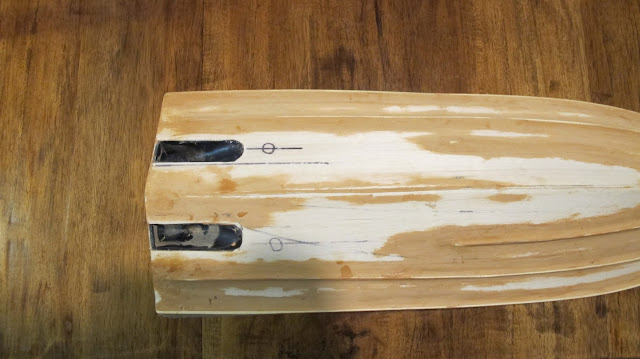
Twin NQD jets modified with brass stern tubes.

I have alternate nozzels which are a little larger than standard also.


Brass impellers made from cutdown brass props

Two P2632 Brushless Outrunner 3800kv Brushless


Stern Tubes brass shafts wrapped in PTFE tape until they fit the tubes. Will be setting up air cooling system with small EDF fan.

Will probably run two 2200mAh Lipos and 50 Amp aero ESCs with big heatsinks


For the cooling I may have the Arduino open and close a vent with a servo if the heatsinks get hot, as well as controlling the fan speed. 


Based on yellow boat plans different deck 390 Grams as shown 
Also Ply fiberglass epoxy catamaran build log

Glass and epoxy inside balsa ply, will epoxy the outside too. Its very strong with builders fiberglass tape and epoxy 


The motors will be mounted further forward on a cooled plate 


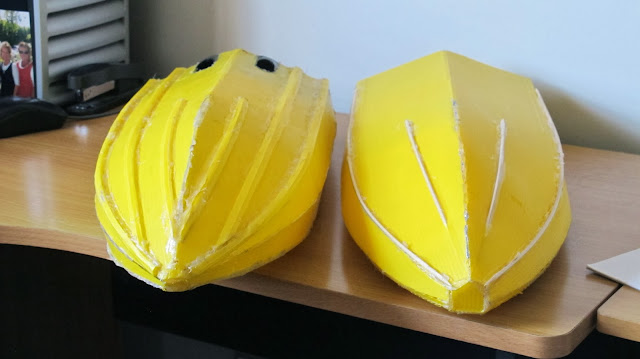
Spray rails are bamboo barbecue skewers and wood filler  


Read More..