Tampilkan postingan dengan label charleston. Tampilkan semua postingan

April 21 22 Charleston SC to Wrightsville Beach NC 155 7 Miles

We left at 10 as planned, but I screwed up reading the tide table so the tide was against us on the way out of Charleston, though weakly. We put up the main in the inner harbor and jibed it several times on the way out, past Fort Sumter where our Civil War began. Actually it began in SC, earlier, with the thinking of Calhoun, on the theory of states rights to "nullify" federal authority, a doctrine now becoming popular again among the lunatic right in this country.
We turned left as soon as we reached the first buoy after the end of the seawall and put up the genoa as well. This was before noon but the wind was too weak and too far behind us, to move the boat with  any speed, so we motor sailed, mostly motored, until about 1:30. I even had taken down the mainsail. I had not realized how much of the first 109 mile long part of this passage, was more easterly than northerly and so the projected five to ten knots of west wind was behind us. Then came wind, much stronger than projected and a gift to us. I was able to get up half the mainsail, with double reef in it, and continued with the genoa. The wind built behind us and we were screaming along at seven to eight knots with peaks at 8.9. And with the wind about 120 to 150 degrees from our bow, we rolled a lot from side to side, most unpleasant. Lene felt a bit nauseous though she did not lose her food. We had a delicious cold dinner -- no cooking with the rolling. It was warm and sunny by day and reasonably warm at night, with no rain. But during the night we got some slow speeds, less than four knots and even though I did not put up the genoa again until near daybreak, it was this night part, as well as the first few hours, where we lost time
After dinner, at 7:30, we replaced the genoa with the small jib, a safety measure for nightime sailing in big waves, and were still making over seven knots with just the small headsail and double reefed main. We had put on the preventer to prevent accidental jibe of the mainsail, and with the small jib sliding back and forth we took it in and sailed under just double reefed main. The preventer was a good thing because the wind had shifted from off our starboard quarter, to off the port quarter during Lenes watch. We were sailing "by the lee" -- the way you get that accidental jibe. When I got up at one (Lene let me sleep late) we jibed the main and continued on toward the turning point - off the tip of Frying Pan Shoals, which extend many miles out into the Atlantic from the Cape Fear River. We saw very little traffic: Two big freighters passed us at quite respectable distances -- closest point of approach being miles away -- and one sailboat overtook us, headed for Beaufort. I saw his lights and estimate he was 200 yards off our starboard side, moving a fraction of a knot faster than ILENE. Prior to the close passage I had a radio conversation with him to confirm what each of us was going to do.
Once around Frying Pan, at about 4 to 5 am, we turned north to Wrightsville (The Masonboro Inlet) and the wind came up from our port quarter to its beam and even forward of that. This second leg was only 32 miles and wind speed varied considerably during the leg, as, consequently, did boat speed.
It is hard to get good pictures of a night passage so at least I have the long awaited dawn.
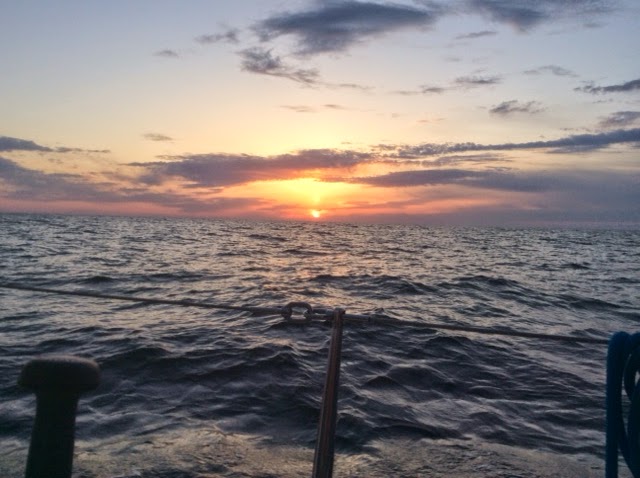
Masonboro Inlet is easy, wide, well marked and flanked with seawalls. Once in, it is easy to get to the anchorage area and we dropped at 1:30, only 90 minutes "late" compared to our projected schedule that would have averaged 6.5 knots. Nice homes line the bay side of the barrier island.
We put out a lot of chain because there is lots of room and 20 knots were predicted for this evening. But by 4 pm it was howling at up to 40. We visited Wrightsville and made the reciprocal of this same ocean passage, to Charleston on our way south last fall and hence felt no need to lower and raise the dink to stretch our legs in Wrightsville. Tomorrow: Beaufort NC, about 80 miles and if the forecast comes true, a beam reach  or close reach from the port side, with five to fifteen knots.
I  tried to take a photo of the pod of dolphins playing under and around our bow, taking the Ipad up there, but they are way faster than ILENE at eight knots. I took maybe 50 shots and only one, a video of less than one second, caught a dolphin. These were not the slow graceful swimmers in the ICW but racers amidst the big ocean waves. I couldnt get the video into this post but it is on Facebook. I did manage to neither fall off the boat nor drop the camera.
Ilene is a true member of this crew and a solid citizen on overnight passages. She grumbles a bit and still relies on me, and I have to admit I like the  second part of that. She is even taking an interest in the charts, tides and weather. I couldnt make this trip without her, physically, mentally or emotionally. We have some chores that each of us do most of, but both of us do many of the chores. She said she liked our 25.5 hours together.
On our honeymoon on the old ILENE, in August 2002, we spent a pretty terrible 36 hours in a noreaster off the coast of Maine  The boat got beat up (torn sail, water inside through the dorades, compass light out) and we got beat up too. After a good nights sleep Lene asked, "Where do we go next?"  I replied "God, I married the right woman!"  And that has become truer with each passing year.
Read More..

November 13 and 14 Charleston to Tom Point Creek to Beaufort SC 60 6 Miles


Charleston is like New York in at least one way: both were started at the confluence of two rivers, and the point of juncture is a park and called The Battery.
It is surrounded by lovely stately old homes.  But you cant sail by close because a sand spit extends out from the point.

A pretty easy day of it, 9:45 to 3 pm, motoring all the way in the ICW, which was wide and deep. Cold but not unpleasantly. We made a connection with the boat next to us in the Charleston Marina, "Kachina", a Hans Christian 33, with the most beautifully treated teak.
It is sailed by John and Joanna currently from Colorado but originally from Canada and Marthas Vineyard, respectively. We exchanged cell numbers and stayed close to them all day. We had originally selected Steamboat Creek for the midway anchorage to Beaufort, but Lene read about Tom Point Creek after it was recommended by Jim of "Goldie,"
a home made, steel, blue schooner. So the Admiral changed our destination. The two creeks are only about a mile apart.
The only obstacle today was one low bridge that opens every half hour from 9 to 3:30, only about 4.5 miles from the marina. We left when we were ready and the marina had sent a man to help a boat come in, so he stayed and helped us get off. But it was too late for the 10 am opening so we went very slow for the first 4.5 miles and got there in time for the 10:30 opening and still had time to get through Elliot Cut before its very swift tidal flow turned against us at 11:15.  After anchoring,  I lowered the dink and used it as a platform to get some rust stains out and polished some stainless, before being chased inside by the cold. A cold front with stronger winds passed during the period midnight to 2AM, but our anchor held.

Where is Tom Point Creek, you asked? Oh, it flows into the Wadmalaw River. It runs between Stann and Little Britton Islands. Still no help? Well you wont find Tom Point Creek in Google, except for information on the tides there, but it is about 20 feet deep and just wide enough for a single column of boats to anchor, and swing with the tidal change; a strong tidal current runs through it, For the curious, look in Google Earth at 32 degrees, 38.75 minutes North; 80 degrees, 16.86 minutes West.  It is bordered by salt marshes on both sides
and the book said -- and correctly so -- that dolphins swim up the creek, playful looking but looking for food.


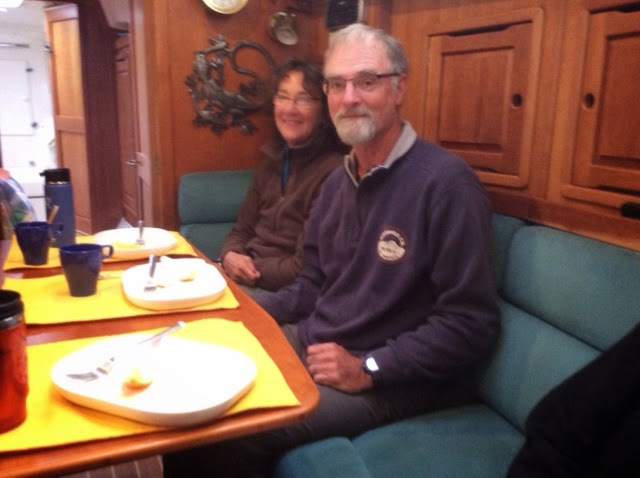
In the morning all six of us had mango pancakes before setting off at about 9:30.
Joanne and Jim

Jim and Susan
Both John and Jim are very handy, the former a carpenter and boat builder, the latter a mechanic who built Goldie and who has lived aboard for 40 years. Both are professional delivery captains so they know something about sailing, in fact, a lot!
When we pulled the hook I did the math: with the Ladies Island Bridge, near Beaufort, closed from 4 to 6 and it being dark by six, we needed speed to get to that Bridge, from which is less than 1/4 mile more to the Downtown Marina of Beaufort. We supplemented the engines power with the small jib and trimmed it on every point of sail during the twisting ICW to gain an extra knot or two. We slowed down only in the three "Cuts" between different rivers. The cuts were short but reported to be shallow, though no problem for us today. A passing shrimp boat, its wings out, surrounded by its posse:
 We made the 3 pm opening, with the grace of the kindly bridge tender. The hundred cars and trucks lined up waiting until 3:06 when we passed, may not have thought of her so kindly, though. I think it was Lenes feminine voice that prevailed upon her to wait for us.

We plan to be on docks, here and in Hilton Head, for several days, using dock power to provide heat until the polar vortex goes away.


Read More..

November 10 12 Three Lay Days in Charleston Zero miles

A municipal manhole cover. Carol is Greek (or Latin?) for Charles and Polis, as in Annapolis or Metropolis, is city or town, hence Charleston, founded in 1670.

There are only three requirements if you want to cruise like we do, the other things are subsidiary. One is time. You need to be retired or independently wealthy or on a sabbatical or unemployed.  Second is money. Not a lot, but you need to buy a boat and maintain and provision it. And third, but no less important than the other two, is good health. On arrival here I thought we had run out of good luck with the third requirement. Lene was bent over with excruciating pain in her left knee. Every few steps was an attack of acute pain. We cant go on like this I thought. She cant climb over life lines and take big steps down from deck level to dock level or transfer between boat and dink.

I told her that we could haul the boat in a yard here in Charleston for the winter, fly home, get the medical problem fixed and come back here next spring and sail ILENE back to New York. The end of the adventure. But then I thought, before such a drastic decision lets get some medical advice. We consulted with our friend Bill, in Oriental, who is a retired Orthopedist. We took a cab to Roper Hospital where x-rays were taken by the ER doctor who gave us a referral for an ASAP visit with an orthopedist on their staff. The ER physician also gave Lene a soft splint, held in place by foam rubber and velcro, which essentially immobilized the knee, causing a very wobbly gait but the absence of the pain, and a prescription for anti inflammatory/pain killers. And these really helped a lot and Lene was walking, slowly but without pain, up to 3/4 of a mile each way. The orthopedist told her to "sail on," resting the knee when possible and using the pills and splint as needed. Her condition has a fancy name and is exacerbated by cold weather. Surgery, replacement and even cortisone can wait. Here is our sick bay, notice the flowers, and the gekko, to the right, below the clock, with short bits of weatherstripping hidden behind it so as not to mar the cherry wood. He will be a reminder of both our Carribean adventure and this trip.

Fortunately,we had spent a week here in the Spring of 2012 and seen most of the major sights, and can stop here again on the way home, because we did no sightseeing on this trip. We did laundry (it is free for boaters in this municipal marina, The Charleston Maritime Center, purchased a new Ipad to replace the one I ruined with salt water in the Chesapeake, and grocery shopped in Harris Teeters, a pretty good supermarket. We took a walk among the historic homes here


(notice my shorts; a warm day at last!) to
 a memorable lunch at Jestines with great inexpensive southern cooking and named after a domestic servant who died in 1997 at age 112, the daughter of an ex slave and a Native American. Jestine worked for a southern family for many years and the restaurant is owned by a descendant of that family. The Reverend Brown of the nearby Methodist Church and the financial secretary of the church recommended the fried chicken which Lene enjoyed and I had, among other things, fried chicken livers, fried okra, corn bread with butter and honey and southern pecan pie.

And of course there is always boat work: ILENE had a bath, her water tanks filled, her fuel tanks poisoned to prevent the growth of microorganisms that clog the fuel lines, gluing back one of the buttons that hold plexiglass panels in place against the screens of the cafe doors with gorilla glue and the top of the percolator lid with JB Weld, a metal to metal glue that is remarkably strong.

But the two biggest problems required the help of Dr. Bill, who, I told him, enjoys fixing boats almost as much as fixing peoples bones. As to the auto pilot, the most expensive component is the motor with linear drive -- the thinner rod to the left goes in and out of the thicker rod to the right, and pulls the rudder to steer the boat. The squeaking and beeping is a $ign of old age and thiS drive will have to be replaced $oon. Its kind of amazing that a guy who is 6 3" could contort his body to reach this place to copy down the serial numbers. Replacing the unit will be harder, but once replaced this one will be rebuilt and used as a spare.

The other problem was the lack of charge into the starting battery. Its sole purpose is to power the starter motor which turns on  the engine. So it discharges only for less than a second each time, but it uses a huge amount of power when it does. And the problem was that it was not being charged by any of the solar panels, the engine or shore power. So the voltage had gradually reached the very low level of only 12 volts. Bill talked me through a series of tests, via phone, which showed that either ILENE does not have a needed "combiner" or that component is not working.  The short answer is that periodically, when we are (A) on shore power with the built in battery charger turned on, or (B) running the engine, we have to combine the starting battery with the "house bank" (which consists of 6 six volt golf cart batteries), so that the starting battery can get charged. This is easily done using a small red plastic key.  Last winter the old starting battery died because I did not know this and erroneously assumed that when I hooked the boat to shore power with the battery charger on, it was charging both batteries. So many lessons to be learned. Thanks again Bill.
Read More..

April 20 Beaufort SC to Charleston SC 57 2 Miles

I forgot something that happened in Beaufort, probably because Id rather not remember. While we were in the theater we heard a loud storm going on outside. Some water came into the boat through the mast boot but that was easily picked up. I learned to dispose of a used American flag with respect. We had retired one at the beginning of this cruise which had been torn to tatters by the wind. But the wind tore our newish flag -- and its flagpole -- off from the boat. I will figure out a more secure way of attaching the next one.
Yes, I know I said we had decided to anchor in the Stono River, just short of Charleston, but our speed was so good today that we made the 3:30 opening of the Wappoo Creek Bridge and never had to deal with the fact that if you dont make the 4:00 opening, you have to wait until 6;30. It seems by dumb luck, we had favorable tide and the deep water of high tide most of the nine hours we were underway from 7 am to 4:00 pm. The favorable tide is proven by our average speed - 6.3 knots.
I have thought of several additional reasons why it is impossible for that hypothetical Ph.D. to figure out a tide algorithm. It depends on where in the river you sail: in the center the tidal flow is different from nearer the sides. It varies during the six plus tide cycle, slow at the beginning and end and fast in the middle. At bends in the river, one side flows faster than the other. And when you add in motor-sailing, as we did all day today, your speed will depend on the wind direction and speed which vary from minute to minute, relative to the boats course which was a near continuous curve, and on the diligence and skill of the trimmer. Today the wind was generally from near our stern and the small jib self jibed many times, as it is designed to do. I hope to never mention that crazy hypothetical algorithm again.
It was a cool but not cold day, warming up in the afternoon, with hazy sun poking amidst the light clouds. No rain.
We had two small problems near the end. I bumped into the throttle lever while walking past the binnacle, decellerating our RPMs and bringing back the "alignment" problem that we hoped we had fixed. The rattle was back and big time. But coming to neutral and building up the RPMs slowly -- the rattle was gone again. Something is still wrong and needs to be fixed. Shortly after this I think I caught a crab pot float on our rudder. The wheel became very heavy to turn and our speed was considerably slowed. I think that a crab pot was the cause of the problem but we dont really know. I turned the boat several times and slowed her and if it was a crab pot float, it fell off.
One of the crew at work, doing what he does second best (first is eating!)


Here is Charleston from our anchor on the Ashley River. On our two prior visits here we took a dock at an excellent marina on the Cooper River, on the north side of town, which was full tonight. But we had no plans for sight seeing this time and did not lower the dink.

We have also determined, subject to plans D, E and F, etc., tomorrows (and the next days) passage: to the Masonboro Inlet and the anchorage of  Wrightsville Beach. At 6.5 knots this will take 24 hours, anchor to anchor. We plan to leave about 10 A.M., with favorable tide flushing us out. Decent wind from the west is predicted.
We have also determined our planning deadline for arrival back in NYC -- June 7. Lenes niece, Barbi, and her son, Trevor who we hung with in Amsterdam last June, are visiting and will arrive on June 10. We would like to get home a few days earlier to get settled and unpacked, and those few days also serve a second purpose: as a buffer in case bad wind prevents the Atlantic overnight up the Jersey coast, as it did when I helped Jim bring his 26 foot "Aria" up in about 1996.
Read More..

November 9 and 10 Overnight from Wrightsville Beach to Charleston 162 Miles

To plan arrival times from overnights so as to coordinate with tides, marinas being open and daylight, one has to assume a speed. Divide the distance in nautical miles by speed in knots and you get hours. Several questions in the Coast Guard Captains licence exam involve this fact and an assumed constant speed, which power boaters can more or less maintain. For overnight passages, we assume ILENE will make an average speed of 6.5 knots. We left at 9:30 am with a plan to arrive in mid morning the next day.

But sailboats have only moderate control over their speed, which is largely wind dependent. And it takes a minute or two of going the wrong way while putting up and lowering the mainsail, and relatively slower motoring speeds for the miles of the going out at the beginning and coming in at the end. And our course was lengthened when, due to the wind being directly behind us too slow, we took a wider turn around Frying Pan Shoals to avoid a dead run. That shoal extends quite a few miles out from the north side of the mouth of the Cape Fear River. Conversely, our course was shortened slightly when we cut the last buoy, R2, and passed near Rattlesnake Shoals off the entrance to Charleston. (That shoal is 16 feet below the surface so we could go directly over it, but why take even theoretical chances.) But the greatest variable is the wind. We had a few hours where the wind gave us less than four knots, and two hours in which we made a thrilling 8.5.

We had about three hours of very light rain in the late afternoon. One cant get rainbows without rain.


Some dolphins played with us at dusk.
Our dinner was a delicious and filling hot bowl of peppers, onions, sausages, pasta, red sauce and cheese that Lene had partially cooked before we left; we ate in the cockpit in the dark. Lene maintained the watch from 7 to midnight and I came on for the rest of the trip. It got cold during the wee hours but full foulies and gloves kept the chill out -- no pain. When Lene took over we were going only 3.5 knots on a very broad reach so I authorized the engine at 5 knots and we hauled the mainsail to midships to be a stabilizer. This was a mistake, in the sense that we wasted fuel and engine hours: sometime during Lenes watch the wind came back, and just aft of the starboard beam. So at midnight I eased the mainsheet out and we jumped to six knots. I shut down the engine and let out the genoa to play as well and our speed built to seven and eventually to variations over nine for several consecutive minutes. Eventually, we furled the genoa for the last three hours to delay our arrival. We had a beautiful sunset,

but the sunrise took place "off camera"  because heavy dark clouds blocked the eastern horizon during that event. The night time watches were quite boring due to the absence of even a single other boat out there to be seen, much less to worry about; we really had the ocean to ourselves.

The high speed portion was thrilling. ILENE seemed to be saying "I was born to go fast and Im having fun out here!" Comparatively little heeling, and not big waves, just an exuberant dash through the open seas, out of sight of land with enough light, after the moon came up, to be able to see a bit. "Thanks, Dad", she seemed to be telling me.

In my last post I worried about the auto pilot but it performed very well during this passage. We expect minor variations in our heading among strong forces out there and auto steered admirably, though noisily, with a soft squeaking/beeping sound that I need to investigate.
This bridge is just a bit upstream from us.

Im getting the spring lines in place for our arrival; end of the bridge, right.
Bottom line: we arrived in the Charleston Maritime Center at 10:30 am, 25.5 hours after we left, with an "average" speed of 6.35 knots over the assumed 162 nm.
Read More..