Tampilkan postingan dengan label april. Tampilkan semua postingan

April 21 22 Charleston SC to Wrightsville Beach NC 155 7 Miles

We left at 10 as planned, but I screwed up reading the tide table so the tide was against us on the way out of Charleston, though weakly. We put up the main in the inner harbor and jibed it several times on the way out, past Fort Sumter where our Civil War began. Actually it began in SC, earlier, with the thinking of Calhoun, on the theory of states rights to "nullify" federal authority, a doctrine now becoming popular again among the lunatic right in this country.
We turned left as soon as we reached the first buoy after the end of the seawall and put up the genoa as well. This was before noon but the wind was too weak and too far behind us, to move the boat with  any speed, so we motor sailed, mostly motored, until about 1:30. I even had taken down the mainsail. I had not realized how much of the first 109 mile long part of this passage, was more easterly than northerly and so the projected five to ten knots of west wind was behind us. Then came wind, much stronger than projected and a gift to us. I was able to get up half the mainsail, with double reef in it, and continued with the genoa. The wind built behind us and we were screaming along at seven to eight knots with peaks at 8.9. And with the wind about 120 to 150 degrees from our bow, we rolled a lot from side to side, most unpleasant. Lene felt a bit nauseous though she did not lose her food. We had a delicious cold dinner -- no cooking with the rolling. It was warm and sunny by day and reasonably warm at night, with no rain. But during the night we got some slow speeds, less than four knots and even though I did not put up the genoa again until near daybreak, it was this night part, as well as the first few hours, where we lost time
After dinner, at 7:30, we replaced the genoa with the small jib, a safety measure for nightime sailing in big waves, and were still making over seven knots with just the small headsail and double reefed main. We had put on the preventer to prevent accidental jibe of the mainsail, and with the small jib sliding back and forth we took it in and sailed under just double reefed main. The preventer was a good thing because the wind had shifted from off our starboard quarter, to off the port quarter during Lenes watch. We were sailing "by the lee" -- the way you get that accidental jibe. When I got up at one (Lene let me sleep late) we jibed the main and continued on toward the turning point - off the tip of Frying Pan Shoals, which extend many miles out into the Atlantic from the Cape Fear River. We saw very little traffic: Two big freighters passed us at quite respectable distances -- closest point of approach being miles away -- and one sailboat overtook us, headed for Beaufort. I saw his lights and estimate he was 200 yards off our starboard side, moving a fraction of a knot faster than ILENE. Prior to the close passage I had a radio conversation with him to confirm what each of us was going to do.
Once around Frying Pan, at about 4 to 5 am, we turned north to Wrightsville (The Masonboro Inlet) and the wind came up from our port quarter to its beam and even forward of that. This second leg was only 32 miles and wind speed varied considerably during the leg, as, consequently, did boat speed.
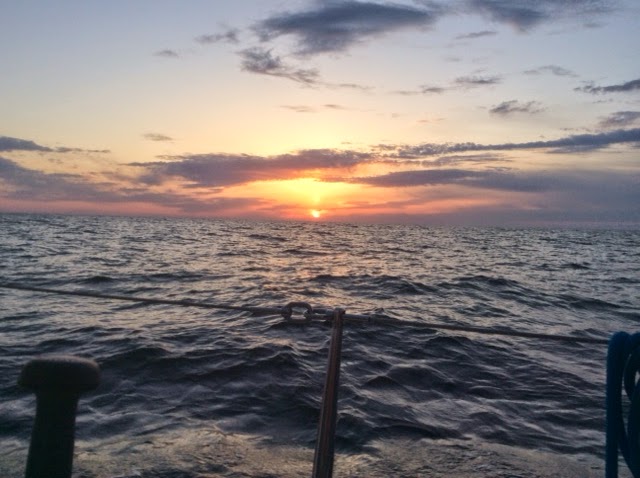
It is hard to get good pictures of a night passage so at least I have the long awaited dawn.
Masonboro Inlet is easy, wide, well marked and flanked with seawalls. Once in, it is easy to get to the anchorage area and we dropped at 1:30, only 90 minutes "late" compared to our projected schedule that would have averaged 6.5 knots. Nice homes line the bay side of the barrier island.
We put out a lot of chain because there is lots of room and 20 knots were predicted for this evening. But by 4 pm it was howling at up to 40. We visited Wrightsville and made the reciprocal of this same ocean passage, to Charleston on our way south last fall and hence felt no need to lower and raise the dink to stretch our legs in Wrightsville. Tomorrow: Beaufort NC, about 80 miles and if the forecast comes true, a beam reach  or close reach from the port side, with five to fifteen knots.
I  tried to take a photo of the pod of dolphins playing under and around our bow, taking the Ipad up there, but they are way faster than ILENE at eight knots. I took maybe 50 shots and only one, a video of less than one second, caught a dolphin. These were not the slow graceful swimmers in the ICW but racers amidst the big ocean waves. I couldnt get the video into this post but it is on Facebook. I did manage to neither fall off the boat nor drop the camera.
Ilene is a true member of this crew and a solid citizen on overnight passages. She grumbles a bit and still relies on me, and I have to admit I like the  second part of that. She is even taking an interest in the charts, tides and weather. I couldnt make this trip without her, physically, mentally or emotionally. We have some chores that each of us do most of, but both of us do many of the chores. She said she liked our 25.5 hours together.
On our honeymoon on the old ILENE, in August 2002, we spent a pretty terrible 36 hours in a noreaster off the coast of Maine  The boat got beat up (torn sail, water inside through the dorades, compass light out) and we got beat up too. After a good nights sleep Lene asked, "Where do we go next?"  I replied "God, I married the right woman!"  And that has become truer with each passing year.
Read More..

April 17 19 Redbird Creek to Beaufort SC and Two Lay Days There 66 5 Miles

We hauled the anchor at 7:15 to get to Hell Gate about 30 to 60 minutes before high tide at 8:40, measured at a tide station only 2.5 miles from that canal. It was cold and windy -- in the wrong direction -- but we passed through Hell Gate with no less than nine feet of depth -- about six more than would have been there at low tide. We got such an early start and partial favorable tides, that we changed our destination from Bull Creek to Beaufort SC, which had been scheduled as the next days destination; we got onto a mooring, rather than their dock where we had stayed our last two times here at 5:05 pm.  Generally the tides were running to the sea from high tide near Hell Gate for six hours and then rushed upstream. The course was so circuitous and involved going upstream on some rivers and down on others that it was always a surprise to us when we entered a new segment to find out which way the tide was flowing. With 2500 rpms on the Yanmar our speed varied from 4.8 to 8.4 knots depending on the current. Maybe some Comp Sci Ph.D. could solve the riddle of when is the best time to leave from point A to go to Point B, depending on your boats speed, unadjusted for tide, and the date in the lunar cycle. But I cant game nature. I mentioned hairpin curves and here is an early part of the passage
from the pliers at the right, through Hell Gate  at the screwdriver tip, upper right, past one hairpin curve above the big washer to just above the wrench jaw at the left. Overall,  the course for this segment was about 30 degrees, or north of northeast.
The portion of the days passage before we got to and crossed the Savannah River was new to us. It took us past Thunderbolt, the boating capital of Georgia. We had heard so much about this place, so close to Savannah, including that the marina brings you a free Krispy Kreme doughnut in the morning. Here are its boatyard and marina and a big beauty. I wonder how she got in this far from the sea with her mast vastly exceeding 65 feet in height.


We also passed Paris Island and Hilton Head, both of which I mentioned during our voyage south last fall.  We tried to motor sail in the afternoon, when we got to Port Royal Sound and the Beaufort River the last 14 miles, but the wind had died down and our speed brought it to our nose.
Our stay in Beaufort was quiet. Unlike our last two visits here, we took one of the marinas moorings. We used the marinas courtesy car to spend $290 at the Publix on Ladies Island, across the river. We off loaded several days of our garbage, filled our four one gallon water bottles, met with friends, including a pot luck dinner ashore. We had planned only one lay day, but the forecast weather seemed worse on the second lay day and we like it here so we stayed.
We made a date with Carla, co-owner of another Saga 43, "Reverie", as she was driving past this town between Charleston and Brunswick. But she had a friend as a passenger who did not want to stop, so our rendezvous had to be put off until the fall when, hopefully, Carla and John, who we have not yet met in person, will be driving through New York on a day when we will be there.
We spent some time discussing whether to divide the segment from Beaufort to Charleston into two halves, as we did on the trip south, but in the end decided to go almost all the way to Charleston and anchor in the Stono River, just south of the city. This solution avoids two problems. 1. It is hard to find a berth in Charleston due to Race Week. 2.  There is a strong tide under a bridge that is closed for rush hours which we have to pass at the end of another long day, just before Charleston.
We saw a matinee of Noel Cowards "Blithe Spirit", at the USC Beaufort campus theater. We sat next to Louise and Jim, nice folks, who recommended "Narrow Dog to Indian River" by Terry Darlington, which I am recommending to Dick and Elle.
Though in a university setting, the show was put on by the local theater group and funny, a farce: during a seance with a medium a mans wife comes back as a ghost visible only to him and torments his new wife. And only $20 per ticket for good seats.
And having had dinner and breakfast at Low Country Produce, located in the former City Hall, during our trip south, we had lunch there this time. Innovative inexpensive food in a place with cloth napkins  which also retails its food; one sits among display cases and racks.
The dink is hauled and we have to get underway early tomorrow to make the 7 am opening of the Ladies Island Bridge, less than a quarter mile away, or wait until 9:00.
Read More..

April 4 Titusville to Rockhouse Creek New Smyrna 31 2 Miles

Well the good news is that apparently felines have short memories. So Witty is not a permanent victim of Post Traumatic Stress Disorder, but his old pesky self. It was Saturday, the day before Easter, and warm and sunny so EVERYONE was out on the water. We saw hundreds of boats from Stand Up Paddleboards, to kayaks and canoes,


to fishing boats of all sizes,
to what I call motorized rafts.
And people were wading and swimming in the ICW too.

I put out the genoa and later the small jib but the wind was too close to our bow much of the time and too erratic. Anchor to anchor from 9:30 to 3:00. Only two opening bridges, one on request and the other every twenty minutes, which we made easily. The tide helped us the last third of our passage, except the last mile, once we got to Ponce de Leon Inlet, and we turned down the engine to near idle speed to give the watermaker two hours to make water before we arrived. We passed some nice modest waterfront houses
and some waterfront trailer parks also known as fishing camps....I think.

Rockhouse Creek runs east-west, connecting two  N-S waterways. (It is the horizontal in an "H".) When we arrived it was very crowded with perhaps fifty small boats and a few large ones. Folks had gone to the beach. We can only enter from the ICW, western end because it gets too shallow for us at the other end, but many powerboat people think that circumnavigating the unnamed island that forms its south side is a nice trip. We heard five of them comment on ILENEs name as they passed us. We had dropped anchor and settled in and by six p.m. there were only three boats left (one other sail and a trawler)
and we were too close to the sailboat, especially because there was so much room everywhere else and strong winds from the east were expected. So we picked up and dropped 150 feet further away from that sailboat. Our other neighbors were a family of campers.
There was no one on the other side of us, where we would turn right and be back in the ICW.

Im having trouble with the new snubber hook, (as well as the underline function) specifically in getting it to stay hooked onto the anchor chain; it falls off and dangles uselessly under the boat instead of doing its job. I tried tying it on but this wasnt working well so I next tried wrapping one side of the hook with rubbery tape to narrow the slot into which the chain sits, but that fell off. 
Here in Rockhouse, I knew it had fallen off when the wind came up at night: the chain took the load instead of the snubber and when ILENE hunted from side to side, the anchor chain snaps over in the bow roller making a sound like the boat is being pounded by a sledge hammer.

I created a way to mount the red and green dinghy navigation light using a suction cup, a piece of scrap plexiglass, a nut, some washers and a piece of thin line.

We have been noticing that Florida has given nicknames to its geography much as in Manhattan, neighborhoods like SOHO and Tribeca that have no legal or governmental significance  are used to define neighborhoods. The southern part of Florida: Miami, Fort Lauderdale and maybe Boca is called the Gold Coast. Heading north, next comes the Treasure Coast including Palm Springs, Stuart and Fort Pierce, so named because Spanish treasure galleons sank off this part of Florida. Cocoa, Titusville and New Smyrna are called the Space Coast. I hadnt noticed this before.


Read More..

March 30 April 2 Fort Pierce to Cocoa and Three Lay Days There 57 Miles

We left the fuel dock at 8 am and anchored at 4:45. Lots of miles but all high bridges except one which opened on request. We went past Vero Beach and Dragon Point, where we had stayed on our way south. This was just as pleasant a passage as the one to Fort Pierce had been ugly. The ICW is deeper, wider and straighter for the most part, and it was sunny and warmer.
A pod of porpoises looked us over while crossing close behind us; we havent seen them for a while. When the tide turned, slowing us from near seven knots to 6.2, the wind came up, just far enough off our starboard bow to allow the small jib to get that speed back for us. We had planned to go outside in the Atlantic to New Smyrna, but the problem with the sunken barge in the Fort Pierce Inlet coupled with winds out of the north made the decision to stay inside until New Smyrna for us -- three passages instead of one.

In the morning the tachometer was not working, nor the engine hour meter. I took off and cleaned the plexiglass cover that protects the panel and the panel itself and jiggled the wires. Jiggling sometimes helps such problems, but no luck today. Then Lene said she had trouble with the ignition switch when turning on the engine. Oh yes, she had accidentally turned it to "Off". After "Start" it should be left "On", but turning it "Off" does not stop the engine -- it only turns off the electricity to its instruments. Switched back to "On" and the tachometer was instantly restored to operation.

A big pleasant surprise when I heard a yell of  "Roger" and saw a dark blue motorized catamaran passing us.
"Its Phat Cat," came next. Dave and Diane, with their two cats aboard, passed us. They resigned from the Harlem and are currently on their last leg (northbound up the Atlantic coast) of the "Great Circle Cruise". They started up the Hudson, and then through canals to the Great Lakes and Canada, down Lake Michigan, the Mississippi, Ohio, Tennessee and other rivers to the Gulf of Mexico, through the ICW east and south along Floridas west coast to Marathon and then northbound in the Atlantic.  This is a trip for power boats; our mast would have to be taken down for the trip, and laid atop the boat, would extend ILENE from 43 feet long to over 65. Dave and Di have been on the journey for about ten months. Since Marathon, they have been in many of the same places we were, but neither of us knew it and we had not met up until now. Their boats name is not on the boat and I might not have recognized it if they had not called out.

We recalled a wild Harlem Memorial Day Rendezvous near Ellis Island in NY Harbor. We had rafted up to Phat Cat and then another smaller sailboat rafted up to our other side and get her mast caught under our back stay. Several men got on top of Phat Cats roof and pulled down to the side on the other boats main halyard to free her. And again, during a Club Cruise, we enjoyed a good time with Dave and Di in Watch Hill, RI.


Phat Cat is a Lagoon 43, built in France, the same length as ILENE but twice as wide, so they have lots of room. It can be rigged with a mast and sails but Phat Cat is not.
The aft stateroom can be divided by a bulkhead down the middle to make two large staterooms if it is used for chartering; but Phat Cat has one immense stateroom, shown here with one of its two cats, Xena or Cassie, reclining on the queen size bed.  She goes faster than us and when we caught up we anchored near her at Cocoa Village, off to the west of the ICW in ten feet of water with 50 feet of snubbed chain.

Dave put down their dink and ferried us around the first night and the next two days that they stayed with us here, before moving on. We had not planned to stay here so long but the nearest place that can do a professional patch on our dink is in St. Augustine and they will not have time to do our job until April 7, so we have slowed down our itinerary to arrive there when they can do the work which will take two days.

We dined on Thai food with Dave and Di at Thai Thai our first night, a pot luck aboard their large boat the second and blueberry pancakes on ILENE the morning of their departure.
Lene making herself at home on Phat Cats back porch.
Dining room with nav station in background

Dave and I dinked across the Indian River to its eastern side where it was a short walk to the local Publix, less than half a mile. The four of us "shopped" Cocoa Village, right by our free dinghy dock, one afternoon. Lene got two pairs of shoes, Dave and Di enjoyed some excellent pastries from the bakery, and we toured Travis hardware, a famous old fashioned place with a huge inventory including tools for use on ocean liners. We bought a better lock to secure the dink to the shore or to the boat,   We are not far from Cape Canaveral where Disney Cruise ships put in with their thousands of passengers. One of the excursions is to take busloads of tourists to Cocoa Village for shopping.

When Dave and Di headed north, we took our dink across to Merrit Island so Lene could get her fix of supermarket shopping. I went back to Travis for a stainless steel snubber hook to replace the rusty mess that we had aboard, and "spline" rubber to affix the new cat proof screening into the frames of the side screens which had been scratched through. I also visited the bank and the Florida Historical society.

They have a good free dinghy dock at Cocoa Village, where one can tie up fore and aft to keep the dink away from the pilings and use the lock amidships to avoid theft. And you can see the shortened tiller extender sticking up, imagine before I cu 18 inches from it!
Lene got a message, her first on this trip, and after dinner at Murdocks,
(southern cuisine --  delicious and inexpensive) we attended the local production of My Fair Lady at the Cocoa Village Historic Playhouse.


And what a treat! The house holds 600. Eliza Doolittle was a sixteen year old. The actors were great and in the choral numbers 48 of them were on stage, supported by an orchestra of sixteen musicians. The costumes and sets were excellent and one would have paid five times as much to see this show on Broadway. Professor Higgins is such a misogynist and yet even today the story is great because the show makes fun of him for it.
Read More..

April 25 26 Beaufort to River Dunes Marina Oriental NC and Lay Day There 28 7 Miles

At 8:10, we had help from the Beaufort Docks staff  "springing" us off the docks so our stern was swung out and we could back out safely. (They hold a line from our stern on the end of the dock while we go in reverse while trying to steer out. It works!)  This was the time of my choosing, but about 10 minutes too soon, resulting in a wait of that duration for the 8:30 opening of the Beaufort Bascule Bridge.
Once clear of the bridge we went perhaps a hundred fifty yards and then aground in mud. There is a fork in the watery path, of which we have to take the right because the left fork was silted in years ago. Mindful of that, I was so vigilant to to not take the right that I took a left, but at  earlier fork, and into a channel that was too shallow for ILENE at low tide. It was low tide so I knew we would float off eventually. But after half an hour I tried another trick. I swung the boom far out to starboard and hung my weight way over the side of the boat to heel her, just a few degrees, to break the contact of the keel with the mud, while Lene gunned the diesel. We were off again, delayed by half an hour, but no worse for wear. It seems I make more mistakes first thing in the morning. This is something to watch out for.
From then on, the only problem was the tide which slowed our progress up the Beaufort River, and through Adams Creek. With low tide at Beaufort at about 9, I thought we would have the help of a flooding tide pushing us on our way up. No such luck. About ten miles up is a high bridge and there the low was at 10:30. I put up the small jib but furled it soon, when it was obvious that there was NO apparent wind to breathe life into it. Even in the broad Neuse River, which we beat down in 2012, there was no wind. Our depth sounder stopped working for about ten minutes but then came back to life while entering River Dunes off Broad Creek. This place was dredged out of the pine forests since our chart was published and has about 160 docks constructed, less than half the number when it is fully built out. They try to make it feel like a Yacht Club, with its own Burgee and Clubhouse with library.


ILENE is at extreme right

We took on a load of fuel at their fuel dock at 3:30, having motored a lot since Jekyll Island, and got on our dock at 4:00.  The rain which had looked threatening all day, held off until the evening and night and during our lay day.
I washed the topsides, cleaned off the rust stains leading from the anchor chain down the outer edge of the starboard side of the deck, where the salt water washdown pump washes the rust particles it takes off the anchor chain, and then waxed this strip to try to keep the rust out in the near future. One shouldnt wax the nonskid deck; it is made rough on purpose. But this narrow strip is now waxed and I have to be careful to tell Lene not to place her feet at the outer edge.
We met some interesting people on our neighboring boats, including a Canadian man on a Catalina 42 with a 185 pound Pyrenese. We dined at the River Dunes Clubhouses dining room, only serving ten dinners that night, in addition to those for a wedding party above. Good food here.
On our day day we were picked up by Bill and Sandy, and served a delicious brunch of baked french toast with ALL the trimmings in their home, with its commanding view of the Neuse. They picked us up at 9 and brought us back at 2:30, so we had a good long time for discussing boats, destinations, books, politics, families, etc.
River Dunes is a relatively new marina, with good wifi and showers. They have an exercise room, pool and sauna. It is very well maintained, only $1.50 per foot and we cashed in the one-time-only Annapolis Boat Show special offer of two nights for the price of one. We liked it here when we visited at about this time of year in 2012 and just as much this time. We hope Bill and Sandy will visit us in NY, perhaps on their way on the loop around eastern Canada aboard m/v Lucille. From NY they would go north on the Hudson, through the Erie Canal, into the Great Lakes, east through the Thousand Islands, down the St. Lawrence River and, after Nova Scotia and Maine, back to North Carolina.
Read More..

April 20 Beaufort SC to Charleston SC 57 2 Miles

I forgot something that happened in Beaufort, probably because Id rather not remember. While we were in the theater we heard a loud storm going on outside. Some water came into the boat through the mast boot but that was easily picked up. I learned to dispose of a used American flag with respect. We had retired one at the beginning of this cruise which had been torn to tatters by the wind. But the wind tore our newish flag -- and its flagpole -- off from the boat. I will figure out a more secure way of attaching the next one.
Yes, I know I said we had decided to anchor in the Stono River, just short of Charleston, but our speed was so good today that we made the 3:30 opening of the Wappoo Creek Bridge and never had to deal with the fact that if you dont make the 4:00 opening, you have to wait until 6;30. It seems by dumb luck, we had favorable tide and the deep water of high tide most of the nine hours we were underway from 7 am to 4:00 pm. The favorable tide is proven by our average speed - 6.3 knots.
I have thought of several additional reasons why it is impossible for that hypothetical Ph.D. to figure out a tide algorithm. It depends on where in the river you sail: in the center the tidal flow is different from nearer the sides. It varies during the six plus tide cycle, slow at the beginning and end and fast in the middle. At bends in the river, one side flows faster than the other. And when you add in motor-sailing, as we did all day today, your speed will depend on the wind direction and speed which vary from minute to minute, relative to the boats course which was a near continuous curve, and on the diligence and skill of the trimmer. Today the wind was generally from near our stern and the small jib self jibed many times, as it is designed to do. I hope to never mention that crazy hypothetical algorithm again.
It was a cool but not cold day, warming up in the afternoon, with hazy sun poking amidst the light clouds. No rain.
We had two small problems near the end. I bumped into the throttle lever while walking past the binnacle, decellerating our RPMs and bringing back the "alignment" problem that we hoped we had fixed. The rattle was back and big time. But coming to neutral and building up the RPMs slowly -- the rattle was gone again. Something is still wrong and needs to be fixed. Shortly after this I think I caught a crab pot float on our rudder. The wheel became very heavy to turn and our speed was considerably slowed. I think that a crab pot was the cause of the problem but we dont really know. I turned the boat several times and slowed her and if it was a crab pot float, it fell off.
One of the crew at work, doing what he does second best (first is eating!)


Here is Charleston from our anchor on the Ashley River. On our two prior visits here we took a dock at an excellent marina on the Cooper River, on the north side of town, which was full tonight. But we had no plans for sight seeing this time and did not lower the dink.

We have also determined, subject to plans D, E and F, etc., tomorrows (and the next days) passage: to the Masonboro Inlet and the anchorage of  Wrightsville Beach. At 6.5 knots this will take 24 hours, anchor to anchor. We plan to leave about 10 A.M., with favorable tide flushing us out. Decent wind from the west is predicted.
We have also determined our planning deadline for arrival back in NYC -- June 7. Lenes niece, Barbi, and her son, Trevor who we hung with in Amsterdam last June, are visiting and will arrive on June 10. We would like to get home a few days earlier to get settled and unpacked, and those few days also serve a second purpose: as a buffer in case bad wind prevents the Atlantic overnight up the Jersey coast, as it did when I helped Jim bring his 26 foot "Aria" up in about 1996.
Read More..

April 6 8 Three Lay Days in St Augustine Zero Miles

Laundry, cleaning and shopping, the usual, except for the shopping which we did by dink to a Publix less than half a mile from a dinghy dock which was about 2.5 miles north of our mooring and on the other side of the shoal infested harbor. We took Lenes i-Navx with us and ended at a boat ramp where Arnis met us with his truck and trailer, took our dink and gave us and our five bags of groceries a ride back to the marina. Two days later he picked us up on the street in front of the marina, drove us back to the boat ramp and launched the dink so we could drive her home to the marina and later to our boat. Hopefully, the gash is history. He said he put a patch on the inside (how the heck is that done) and then a larger one on the outside in addition.

But life is more than chores and repairs. We visited the Villa Zorayda, built by a wealthy Boston man in the 1880s to resemble the Alhambra palace in Grenada Spain, where he had traveled and fallen in love with things Moorish. Of course it is much smaller than the original but its rooms have the same names including a two story central atrium, like Viscaya in Coconut Grove, a harem room with an overhanging window through which inhabitants could look out without being viewed. The house was stuffed with furnishings from throughout Europe and the Middle East, including a "cat rug" in which a mummy was found buried in a pyramid. The house later passed into the hands of a Mr. Mussalem, a respected dealer in antique Oriental rugs and later became a hotel, speakeasy and gambling club. I just loved the floor, composed of square tiles that are each identical but arranged to form two patterns.

I walked to the Lighthouse and back, about four miles round trip. But I could not climb the  219 steps to its light room which was closed for painting. So we were given a guided tour by Don, a retiree who seemed to love his subject. Much of his talk had to do with the work done there and the processes of the preservation of parts of sunken ships, as was done the The Vasa in Stockholm (Blog June 2014) and about a wooden boat building project.
We toured the home that the two lighthouse keeper families and their assistant shared and I thought of the similarities of the US and Scottish lighthouse services. The lighthouse is on Anastasia Island and I checked out the St. Augustine YC, on its eastern side, behind the barrier island, while there.

I visited two historic houses, first the Pena-Peck house, built as a Spanish style open home around a courtyard with shutters but no windows behind them for the Spanish Tax Collector, Senor Pena. After a second story was built in the English style, it became the home and office of Dr. Peck of Whitestone, New York and his family. His decendents lived there until 1931 when the last died childless and the house was given to the city. My docent there was a Ms. Policer,
who had moved back to this area after her husband retired from his work in California. She mentioned that Dr. Peck had lived in the Ximenos-Fatios House, a few blocks away (everything is only a few blocks away in the center of this historic town). I had planned that as my next stop and learned that the house had been one of several boarding houses that competed with hotels in the mid nineteenth century. They were run by women and served nine course dinners as well as multi course lunches and breakfasts. The two names represent the names of the first and last owners during the period that was of interest to the preservationists and in reading the placards I learned that one Menorcan (I would have said Minorcan) woman whose surname was Policer, had married a man who had built or owned this house early in its history. So maybe, my docent at the first house was of Menorcan descent and has roots in St. Augustine that go way back, which she did not mention. Another thing: tourists did not arrive by railroad, car or boat (or airplane); they took a steamer up the St. Johns River past Jacksonville and then by stagecoach, east from that river to St. Augustine.

One attraction that I did not visit was El Galleon, from Spain, which will be here until june and plans to visit Philadelphia next. To get under the Bridge of Lions, she had to trim her spars fore and aft and squeeze through with inches to spare.

Anchor is "catted"


We had two good restaurant meals, the first at Columbia,
which we had visited in 2012, and the second at Collage, a newer place which was one of the few "fine dining" experiences we have treated ourselves to on this trip. Excellent service by well trained, well dressed, efficient, lovely, young ladies and interesting imaginative food. In New York such a dinner would have cost $100 per person; here it was half that. In hindsight the two meals share one thing in common: local spicy smoky red peppers. At Columbia they were stuffed with chorizo and spanish ham and baked under an almond sauce and at Collage they were pureed with carrot in a soup.
And we had a pumpkin/mango pancake breakfast

aboard ILENE with Earl and Kathy of s/v Seeker, friends of Dean and Susan who introduced us to each other in St. Augustine on the way south. One of my favorite feelings is the joy I get when I introduce friend A to friend B and they hit it off. Thanks, Dean.

St Augustine still has several attractions that, even after three extended visits here, we have not seen.
Sunset from our mooring.


Read More..

April 23 24 Wrightsville Beach to Beaufort NC and Lay Day There 80 5 Miles

Underway from 6:45 until 4:00, outside in the Atlantic. Raised main in the harbor, because we were motoring directly into the wind. Then a brief two minute torrential downpour, a right into the inlet and another right outside put us on course for Beaufort. A straight shot at about 60 degrees for 69.1 miles across a good part of Onslow Bay, which is an 80 mile crescent from Southport to Cape Lookout. Out came the genoa and we were doing fine, on a port beat. But the wind was veering very slowly to the right, forcing us a bit more and more off course, not that this was dangerous: thousands of miles of the Atlantic were to the right. But then the winds came up strongly. The clinometer measures us while heeling 39 degrees.


The effect is more dramatic than shown of the clinometer.


We "buried the rail", i.e., water was rushing over the side deck on the leeward side.
So we furled the genoa, put a reef in the main and put out the small jib. Normalcy and safety restored. When the wind diminished a bit we were at a slower speed. Our objective was to be on our dock before night fall, so we turned on the engine and motorsailed. At one point we were pushed so far off course that it was time to tack. Then, instead of being pushed to the right of where we wanted to go, we were being pushed toward the left. As the wind continued to veer or "clock around" to the right, we were able to change course to the right, two degrees at a time, until our course over the ground matched the bearing to the Beaufort inlet.
We met two interesting boats in the inlet, a tug going in and a shrimper coming out.

Beaufort Docks is the municipal marina of Beaufort, with a large,friendly and knowledgeable staff. They gave each of us a wooden nickle, good (with a dollar for a tip) for a free glass of wine at the restaurant/bar of the marina. I had the house red both nights because Lene does not drink. Their showers are not fancy or spacious but clean, with lots of hooks, seats and plenty hot water. They provide a quality wifi at the docks. We used their courtesy car to get a propane refill at a fish store. And also, a delicious fresh flounder that the store fileted for us and Lene cooked that night. We also got groceries. and fresh engine oil for the next change. We each got haircuts from Rachel of Enchanted on the Lane. A mechanic came over to try again with the engines intermittent rattle and did less but charged more than Leo of Jekyll Island -- nothing, except he gave his opinions.
Our other diner was at a restaurant called Queen Annes Revenge, its food adequate. It was named after Blackbeards pirate ship, that sank just outside the inlet through which we had entered.
The North Carolina Maritime Museum had a good exhibit on the recovery of the remnants of that ship along with pirate life generally -- free admission.
There is also a lot there about commercial fishing and outboard engines, but the best part of this museum was about what they called "indigenous boats." These are boats built of locally available wood and designed to do the work needed by the local population and the water conditions they are likely to face. It started with dugout canoes with the best explanation I have heard on how they are created and ended with the sharpies, a type of flat bottomed fishing boat first built in New England but modified and popular in NC waters. They had several full size boats and models in the display. Worth a lot more time than the two hours I had for it.
I also had taken a stroll through the historic town, three blocks by ten blocks in size along the waterfront. Strip shopping malls and other attractions and probably some lovely suburbs are outside of this historic area. Front street is at the waterfront, its business side full of restaurants and shops and, across the small park area to the right, the marinas docks. The kitties did not enjoy it here as much as they had hoped to because a man on our neighboring boat is allergic to cats and was not pleased when he discovered Alfie exploring his cabin. They had to remain aboard.


Old placarded homes, are on the other streets.


The Allen Davis house of 1774, picture above was used by General Burnside in the Civil War but it did not say which side he fought for.


A historic triumph for this rural town was when the Railroad was built here, allowing inland produce to be shipped to market. The Depot remains beside where the tracks used to run
and is now a civic meeting place with a museum including this recreation of the RR office. Both the Railroad office and our barber reminded me of my maternal grandfather who was a barber when young and retired from the railroad office when he got older.
As sections of the Atlantic coast of Florida have been nicknamed the gold, treasure and space coasts, Beaufort and several surrounding towns now call themselves the Crystal Coast. Someone told me this was because the Atlantic water is so crystal clear.
In 2012 we anchored out off the docks here and did not go ashore. We made up for that oversight this time. From here on until Norfolk we will be inside.
Read More..